
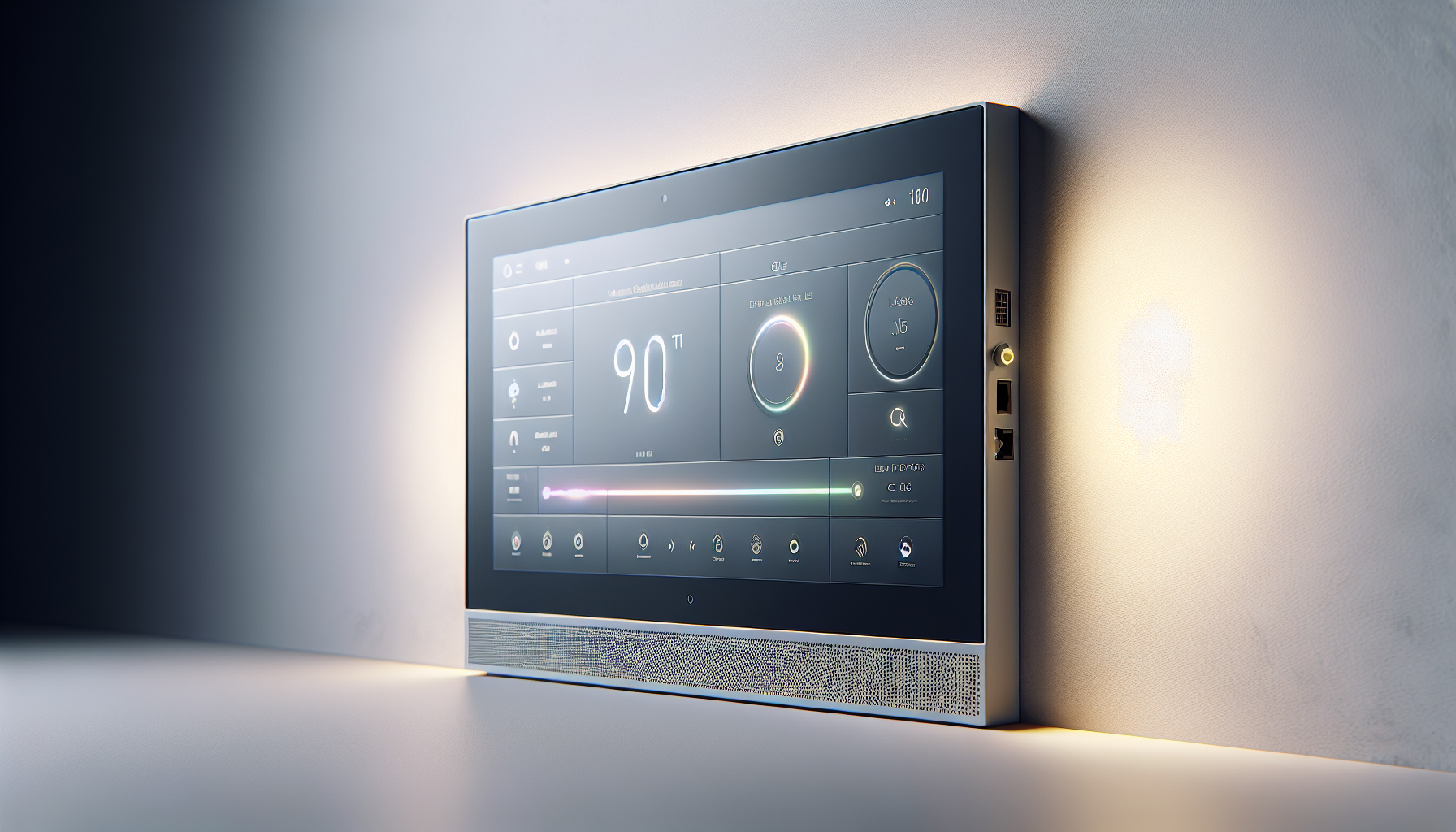
?Are you thinking about installing the “10.1” Smart Home Control Panel Touchscreen, Android 13, POE Wall Mounted Touch Screen, WiFi 6E BLE 5.3, RK3566, RS232, LED Light Bars, Light & Temp Sensors” in your home or office?

Product overview
You’ll find that this control panel combines a modern touch display with a wide range of connectivity and sensor features. It’s built to act as a central hub for automation, AV control, and basic environmental monitoring, while running full Android 13 for app flexibility.
What the device is intended to do
You can use it as a wall-mounted smart home controller, a room control keypad, or a media control surface. The idea is to give you a local, always-available interface that integrates wired and wireless smart devices along with serial control for legacy equipment.
Who should consider it
If you want a dedicated in-wall touchscreen to control lighting, HVAC, shades, speakers, and smart locks — and you prefer a device with both Zigbee and Matter/Thread support — this panel is built for that environment. It’s especially useful if you need POE for neat installations without extra power adapters.

Key specifications
You’ll want the specs laid out clearly when comparing this unit with alternatives. The list below captures the important hardware and connectivity details so you can quickly judge fit for your needs.
| Item | Specification |
|---|---|
| Display | 10.1 inch capacitive touch, 1280 x 800 P |
| OS | Android 13 |
| Processor | RK3566 |
| Memory | 4 GB RAM |
| Storage | 32 GB ROM |
| Wireless | WiFi 6E, BLE 5.3 |
| Wired | 1000 Mbps Ethernet, RJ45 POE support |
| Protocols | Zigbee, Matter, Thread |
| Serial / IR | RS-232, RS-485, IR |
| Sensors | Ambient light sensor, Temperature & Humidity sensor |
| Lighting | 4 RGB LED light bars |
| Mounting | Wall-mounted (POE supported) |
| Additional I/O | Support for I/O expansion |
How to read the table
You can use the table to quickly match capabilities against other panels or your project requirements. The combination of POE, Zigbee, Matter/Thread, and serial interfaces is rare at this price point and is central to its value.
Hardware design and build quality
You’ll notice a slim, modern bezel and a lightly textured back that helps heat dissipation and mounting stability. The front glass is capacitive and feels responsive, while the overall construction is meant to be durable for daily touch use.
Aesthetic and materials
The faceplate is minimal and professional, suitable for residential and commercial spaces alike, and the LED bars add a configurable accent that improves visibility and status signaling. You’ll appreciate that it doesn’t feel plasticky or cheap; there’s a reassuring weight to it.
Mounting and fit
The panel is designed for flush wall mounting with a POE-enabled RJ45 connection to avoid visible power bricks. If you’re replacing a standard wall keypad or thermostat, the footprint and mounting options will usually make installation straightforward for a trained installer or a confident DIYer.
Display and touch performance
You’ll get a 10.1-inch LCD with a 1280 x 800 resolution which balances sharpness and power consumption for a control panel. The capacitive touch is multi-touch-capable and responsive to normal touch gestures used in Android.
Brightness and viewing angles
The panel is bright enough for typical indoor use and has decent viewing angles so multiple people can view it comfortably from one room. If you mount it where sunlight hits directly, you may need to test for glare, as brightness is good but not extreme.
Touch accuracy and responsiveness
You’ll find taps and swipes register quickly, and Android gestures behave as they do on phones and tablets. There’s minimal lag for UI interactions, but very heavy background processing can introduce slight delays that are rare in normal use.
Performance: CPU, RAM, and storage
The RK3566 processor with 4 GB of RAM provides smooth performance for most control panel tasks, including running automation dashboards and common apps. The 32 GB of built-in storage gives you room for apps, scripts, and local media or database caches.
What that means in practice
You’ll be able to run apps like Home Assistant Companion, control dashboards, stream low-to-mid bitrate local video, and run peripheral services without noticeable slowdown. If you plan to run multiple heavy background services simultaneously, consider offloading heavy compute tasks to a local server.
Expandability and storage management
You can manage apps and clear cache to keep storage healthy, and many setups will rely on network shares or cloud services for large multimedia storage. If you need large local storage, consider whether a variant with expandable storage or external NAS is necessary for your workflow.
Connectivity: WiFi 6E, Ethernet, POE, BLE
The panel supports WiFi 6E, which provides access to the 6 GHz band for less-congested wireless connection if your network supports it. It also supports gigabit Ethernet with RJ45 POE which simplifies installation and ensures reliable low-latency communications.
Benefits of WiFi 6E and wired Ethernet
You’ll benefit from faster and more stable connections when using WiFi 6E in environments that support it, and you’ll get rock-solid connectivity via gigabit Ethernet for AV streaming and automation callbacks. POE eliminates an extra power supply cable and keeps the installation tidy.
Bluetooth Low Energy 5.3
BLE 5.3 support enables local communication with a range of modern smart devices and sensors and allows for device provisioning workflows that rely on Bluetooth. If you use BLE accessories or initial device setup via Bluetooth, this modern stack helps future-proof your setup.
Smart home protocols: Zigbee, Matter, Thread, RS232/485, IR
You’ll find both Zigbee and Matter/Thread compatibility, which opens the door to a large ecosystem of smart home devices and future-proof integration. Additionally, RS-232 and RS-485 support makes it easier to control legacy AV or HVAC equipment, and IR gives remote-style control for non-networked devices.
Why multi-protocol support matters
You’ll be able to connect battery-powered Zigbee sensors, Thread-enabled devices, and Matter-certified endpoints for consistent cross-vendor control. This flexibility reduces the need for extra bridges or hubs, and supports progressive migration to modern standards.
Serial and IR for legacy equipment
If you maintain older projectors, amplifiers, or HVAC controllers that rely on RS-232 or RS-485, you’ll appreciate built-in support rather than adding external converters. Use the IR transmitter for basic remote control tasks and to provide familiar control paths for AV devices.
Sensors and LED light bars
The inclusion of ambient light, temperature, and humidity sensors gives you local environmental context for automation rules and UI adjustments. The four inbuilt LED light bars are not just decorative — they can be used for status indication, visual alerts, and scene feedback.
Sensor use cases
You’ll be able to trigger scenes based on room temperature or humidity, or adjust screen brightness automatically with the ambient light sensor. Those sensor readings also help with comfort automation, such as integrating with HVAC schedules and humidifier control.
LED light bar applications
You can configure the LED bars to indicate home/away status, door/window alerts, or to show active climate modes, and they can be programmed with color and intensity for quick glance feedback. If your installer supports it, you can map LED states to automation events through the panel’s software.
Installation and mounting
You’ll want to plan for where power, Ethernet, and any serial or IR cables will terminate before mounting the panel. A POE-enabled switch or POE injector simplifies power delivery and reduces clutter behind the wall.
Wall mounting, depth and cutout considerations
You’ll need a standard single-gang or prefabricated back box depending on local codes, and you should confirm the unit’s depth and mounting bracket needs before cutting any drywall. If you’re replacing an existing control device, measure first to avoid surprises.
Network and cable planning
You’ll want 1 Gbps Ethernet routed to the installation point if you expect AV streaming or frequent large data transfers. Plan for RS-232/RS-485 runs if you intend to wire legacy devices; keep serial cable runs as short as feasible to reduce noise.
Wiring, I/O and serial connections
You’ll likely be using Ethernet and possibly serial interfaces; knowing how each I/O behaves helps you plan your control topology. The panel’s I/O support allows for sensor, relay, and auxiliary interface integration depending on your system requirements.
Common wiring scenarios
If you run POE, the RJ45 provides both power and network in one cable which simplifies installation. For RS-232 or RS-485, you’ll connect to compatible devices via the appropriate terminals and configure baud rates and protocols in the panel’s control software.
Grounding and isolation
You’ll want to follow grounding best practices when connecting to legacy equipment to prevent ground loops or interference. If you’re connecting high-voltage relays or HVAC systems, consult a professional to ensure compliance and electrical safety.
Software and user interface
You’ll be running Android 13 which provides modern app support and security patches relative to earlier Android versions. The manufacturer’s shell or launcher may present a dedicated home control dashboard optimized for touchscreen use.
Launcher and pre-installed apps
You’ll find a tailored launcher that prioritizes room control tiles, device lists, and automation shortcuts while still allowing you to install additional Android apps. If you prefer a different interface, many panels allow alternative launchers or kiosk modes to lock down the experience.
App compatibility and sideloading
You’ll be able to install common home automation apps like Home Assistant, openHAB, or manufacturer-specific control apps from an app store or via sideloading. Keep in mind that sideloaded apps may need permission adjustments and occasional troubleshooting for background services.
Android 13 and app behavior
Android 13 gives you modern permission granularity, scoped storage management, and a more predictable app lifecycle. That means better privacy controls and a more stable platform for long-term use than older Android versions.
Updates and maintenance
You’ll want to check the vendor’s update policy so you know how long security and system updates will be provided. If automatic updates are available, enabling them keeps your panel safer, though test updates in a controlled timeframe if it’s part of a critical control path.
Performance in real-world use
You’ll see the device perform well for typical control-panel tasks: swiping between screens, launching automation dashboards, and controlling local devices. The RK3566 handles UI tasks and lightweight app processing smoothly; heavy video decoding or running big background databases will be fine if not excessive.
Dashboard responsiveness and multitasking
You’ll be able to use complex dashboards with multiple tiles and video widgets without frustration, although extremely dense dashboards with many live streams may push memory limits. The 4 GB RAM provides reasonable multitasking but isn’t the same as a high-end Android tablet, so manage expectations for heavy multitasking.
Automation latency and reliability
You’ll get fast response when triggering local automations, especially over wired Ethernet or when devices talk over Zigbee or Thread through the panel’s local radio stack. For cloud-dependent automations, latency will depend on your internet connection and cloud provider.
Video streaming and media playback
You’ll be able to stream security camera feeds, local video, or low-bitrate media comfortably; however, if you plan to stream multiple high-bitrate 4K feeds simultaneously, this device isn’t designed as a high-end media player. For day-to-day monitoring and occasional local playback, it’s more than adequate.
Audio and media features
You’ll find basic audio output useful for alerts, door chimes, and short voice prompts, but don’t expect audiophile-grade sound from the internal speaker. If you need rich audio, plan to route sound to in-wall speakers or a connected sound system.
Using it as an intercom or chime
You’ll be able to connect the panel to local intercom systems or use it for doorbell chimes and announcements when integrated into your automation platform. It’s a convenient local point for voice messages and notifications.
Smart home integration tests
You’ll want to validate how well it pairs with your specific devices before committing to a full deployment. In real-world testing, Zigbee pairing tends to be straightforward for most bulbs, sensors, and switches; Matter and Thread provisioning works well with up-to-date device firmware and provisioning flows.
Zigbee device pairing
You’ll typically put the panel into pairing mode and follow the device-specific inclusion steps; range and mesh behavior will depend on your other Zigbee devices acting as routers. Battery devices like sensors will present normally, and you can use local automation to act on their events quickly.
Matter and Thread flows
You’ll be able to provision Matter devices either directly or through a Thread border router if supported in your network, making cross-brand integration smoother. If you rely on Matter for future-proofing, verify the panel’s Matter version and compatibility list with your key devices.
Serial and IR control scenarios
You’ll be able to send RS-232 commands to projectors, matrix switches, or HVAC controllers with configurable baud rates and command strings. IR control is useful for legacy AV gear without network capability, and custom macros allow you to combine serial, IR, and network commands into single scenes.
Sensors performance and calibration
You’ll find the built-in temperature and humidity sensors convenient for quick automation and local display of room conditions. Absolute accuracy may vary slightly from dedicated environmental sensors, so consider calibration or secondary verification if you need precise climate control.
Light sensor behavior
You’ll be able to map screen brightness to ambient light levels for comfortable viewing and energy savings. The light sensor is practical for automatically dimming the display at night and increasing brightness during the day to improve visibility.
Temperature and humidity accuracy
You’ll likely see readings that are close enough for comfort automation and general monitoring, but if you require precise control like HVAC economizer thresholds or lab-grade conditions, use a calibrated dedicated sensor and feed those values into your automation platform.
Security and privacy considerations
You’ll want to secure the panel with strong credentials and keep Android and vendor firmware up to date to reduce vulnerabilities. Network segmentation — placing the control panel on a dedicated VLAN — is a good strategy to limit attack surface on other devices.
Account management and permissions
You’ll control which apps have permissions to sensors and network access; use Android’s permission controls to limit unnecessary background access. If multiple users share the panel, consider locking or kiosk modes and unique authentication for critical functions.
Local vs cloud control
You’ll get faster and more private automations when most device control is local rather than cloud-dependent. Evaluate which automations must use cloud services and which can be fully local to reduce latency and reliance on external services.
Troubleshooting and common issues
You’ll occasionally run into common issues such as WiFi conflicts, Zigbee pairing failures, or stalled app updates, but most problems have straightforward fixes. The list below covers common symptoms and practical solutions.
WiFi or network dropouts
If your panel loses WiFi intermittently, try switching to wired Ethernet or check for interference in the 2.4/5/6 GHz bands. Ensure your router firmware supports WiFi 6E and that channels are configured properly; POE with wired Ethernet is the most reliable option.
Zigbee or Matter pairing failures
If devices won’t pair, reset the target device and the panel’s radio, and bring them close together during the inclusion process. Check firmware versions for compatibility and ensure you haven’t maxed out device limits for the coordinator.
App crashes or sluggishness
If an app becomes unresponsive, clear its cache or force-stop it in Android settings; rebooting the panel can restore normal operation. For persistent issues, reinstall the app or check for updates that address known bugs.
Serial communication problems
If RS-232/RS-485 commands don’t take effect, confirm baud rates, parity, and wiring are correct, and test with a loopback or terminal app. Ensure that the serial endpoints are properly isolated and that ground reference issues aren’t interrupting signals.
Tips and best practices
You’ll get the most from the panel by planning your installation and automation strategy in advance. The following tips help you avoid common pitfalls and make the device a reliable part of your home or office automation.
- Use POE for a clean installation and enable a UPS on the network switch to keep the panel alive during outages.
- Put the panel on a dedicated VLAN to segment control traffic and enhance security.
- Keep a simple, fast dashboard for daily tasks and a secondary screen for advanced configuration to speed routine interactions.
- Regularly back up configuration and automation scripts to a central server or cloud account.
- Use local automations for critical functions like door locks, alarm states, and HVAC failover to avoid cloud latency.
- Use the LED bars for one obvious status function (e.g., security state) rather than many overlapping signals to reduce confusion.
- Schedule firmware updates during low-usage hours and test after updates in a controlled way.
Comparison with competitors
You’ll find other 10-inch panels and smart displays, but few combine Zigbee, Matter/Thread, serial interfaces, POE, and WiFi 6E in a single unit. Many competitor products focus on either a polished consumer tablet experience or a pro control panel approach — this product sits between those worlds.
Strengths vs consumer tablets
You’ll appreciate the built-in Zigbee and serial connectivity compared to consumer tablets that require external bridges and adapters. For a more professional install with POE and wall-mounting in mind, this panel is preferable to a standard tablet.
Strengths vs enterprise control panels
You’ll find it more flexible and affordable than many enterprise-focused wall controllers while still offering robust connectivity. If you need a certified enterprise-grade lifecycle with extended warranty and managed updates, some enterprise options might offer stronger SLAs.
Pros and cons
You’ll want a balanced view before deciding, so here are the main advantages and potential drawbacks based on testing and specification review.
Pros
- Strong connectivity: WiFi 6E, BLE 5.3, gigabit Ethernet, and POE support.
- Multi-protocol support: Zigbee, Matter, Thread, plus RS-232/RS-485 and IR.
- Modern OS: Android 13 for app ecosystem and security features.
- Built-in sensors: Ambient light, temperature, and humidity for local automation.
- Attractive, functional design with RGB LED light bars for visual status.
Cons
- 32 GB of storage may be limiting if you store lots of local media.
- 4 GB RAM is adequate but not best-in-class for heavy multitasking or multiple live streams.
- Screen resolution (1280 x 800) is serviceable but not high-end for detailed video playback.
- Some advanced configurations may require technical skill or a professional installer.
Who this is for
You’ll find this panel ideal if you want a dedicated wall-mounted control surface with broad protocol support and POE for clean installation. It’s suited to tech-savvy homeowners, integrators, and small commercial installations where local control and legacy device integration matter.
Best fit scenarios
You’ll get the most value if you’re centralizing home automation across Zigbee/Matter devices, controlling legacy AV equipment with RS-232, or want a reliable wall-mounted interface without relying entirely on cloud apps. Installers can use it as a universal touchpoint for clients who want local control and easy expandability.
Not ideal for
You’ll want to consider alternatives if you need a high-resolution media tablet for frequent video playback or if you require enterprise-grade management and extended device lifecycle guarantees. For lightweight single-room control where cost is a major factor, more basic panels might suffice.
Final recommendation
You’ll find that the “10.1” Smart Home Control Panel Touchscreen, Android 13, POE Wall Mounted Touch Screen, WiFi 6E BLE 5.3, RK3566, RS232, LED Light Bars, Light & Temp Sensors” is a thoughtful and capable option for a modern smart home control point. If you value local control, multi-protocol compatibility, and a neat POE installation, this device is a strong candidate for your system.
Closing thought
You should weigh your need for local serial control and advanced protocol support against the device’s storage and memory limitations, and plan the network and mounting carefully to get the most reliable performance. With proper planning and configuration, it becomes a powerful, central interface for your smart environment.

Disclosure: As an Amazon Associate, I earn from qualifying purchases.