
Looking for a reliable smart hose timer that actually makes watering your yard easier and less stressful?

Quick Verdict
You’ll find the RainPoint WiFi Water Timer for Garden Hose with Brass Inlet, 2-Zone Smart Hose Timer, WiFi Irrigation Controller, Automatic Sprinkler Watering System for Lawns and Yard to be a solid blend of convenience and functionality. It gives you remote control through a mobile app, two independently programmable zones, and smart features that reduce the number of manual tweaks you need to manage your garden.

RainPoint WiFi Water Timer for Garden Hose with Brass Inlet, 2-Zone Smart Hose Timer, WiFi Irrigation Controller, Automatic Sprinkler Watering System for Lawns and Yard
$99.99 In Stock
First Impressions
When you first handle the unit, you’ll notice the brass inlet feels reassuringly durable compared with plastic-only alternatives. The device looks ready for outdoor use and the controls are straightforward, so you won’t feel lost during setup. The packaging and included hardware are generally what you’d expect for a mid-range smart irrigation controller.
What’s in the Box
You’ll get the main dual-zone timer unit, a smart hub (if included in the bundle you choose), mounting hardware, and a user manual. The hub is necessary for stable connections and for enabling multiple-device networking. If you buy the controller without the hub, make sure your network setup still supports the features you want.
Product Specifications (At a Glance)
Here’s a concise breakdown so you can scan the key specs quickly.
| Feature | Specification |
|---|---|
| Product Name | RainPoint WiFi Water Timer for Garden Hose with Brass Inlet, 2-Zone Smart Hose Timer, WiFi Irrigation Controller, Automatic Sprinkler Watering System for Lawns and Yard |
| Zones | 2 independently programmable zones |
| Inlet Material | Brass |
| WiFi | 2.4 GHz required |
| App | RainPoint Home APP (iOS & Android) |
| Watering Modes | Normal, Interval, Cycle & Soak |
| Watering Duration | Normal/Cycle: 1 min – 12 hours; Interval mode: 1 sec – 60 mins |
| Frequency Options | Daily, Weekly, Odd days, Even days, Every 2–30 days |
| Schedules per Zone | Up to 6** |
| Smart Features | Smart Scenes, weather-based adjustments, seasonal adjustment (10–200%) |
| Voice Assistants | Alexa, Google Assistant |
| Expandability | Up to recommended 4 timers per hub |
| Family Sharing | Yes |
| Recommended Hub Limit | Up to 4 timers for stability |
**You can set up to 6 watering schedules per zone, so you’ll have flexibility for different plants and watering needs.
Design and Build Quality
You’ll appreciate the brass inlet — it gives better thread strength and durability where your hose connects. The outer case is weather-resistant plastic and feels robust enough for a typical garden environment. The dual-zone form factor is compact and won’t take up too much space by your faucet or hose bib.

Installation and Setup
Setup is designed to be user-friendly, especially if you’re comfortable with smartphone apps. You’ll attach the timer to your faucet, connect hoses to the two outlets, insert batteries or plug in power if your model supports it, and follow the app prompts to register the device. The RainPoint Home APP requires a 2.4 GHz WiFi network — make sure you have that available.
- You’ll pair the timer to the hub (if you have one), then connect the hub to your home WiFi.
- The app guides you through naming zones and creating your first schedules.
- If your signal is weak at the faucet, you may need to move the hub closer or use a WiFi extender.
RainPoint Home App: Control and Usability
You’ll control everything from the RainPoint Home APP. It’s where you create schedules, run manual watering, view history, and set up smart scenes. The interface is generally intuitive and clearly labels zones and events.
- Remote Control: You can start, stop, and check watering status from anywhere as long as your phone has internet.
- Watering History: The app records run times so you can audit what happened and when.
- Family Sharing: Add other household members so they can control watering without sharing your login.
Scheduling Options and Flexibility
You get a lot of scheduling flexibility. Each zone can have up to six schedules, which is enough for complex needs like different plant beds or mixed-use areas (lawn vs. raised beds).
- Frequency Options: Daily and weekly scheduling is standard. The odd/even day options are handy if you need alternating-day plans or comply with local watering restrictions.
- Every 2–30 Days: Use this to space out watering for drought-tolerant plants or vacation-style schedules.
- Duration Ranges: Normal cycles let you set long durations (1 minute to 12 hours) ideal for drip irrigation and slow soaking. Interval mode (1 sec–60 mins) is great for frequent short pulses, and Cycle & Soak helps prevent runoff on slopes by breaking watering into repeating segments.
Watering Modes Explained
You’ll appreciate having three distinct modes because each has clear use cases:
- Normal Irrigation: Set a single continuous run time — ideal for sprinklers or general watering.
- Interval Irrigation: Use for timed pulsing or devices that require short frequent bursts (useful for certain drip setups).
- Cycle & Soak: Breaks the overall watering schedule into cycles with soak periods in between to let water absorb, reducing runoff and improving uptake.
Smart Scenes and Weather Integration
You’ll be able to use Smart Scenes to automate behavior based on conditions. The RainPoint system can adjust watering according to weather and can link multiple RainPoint devices for coordinated control.
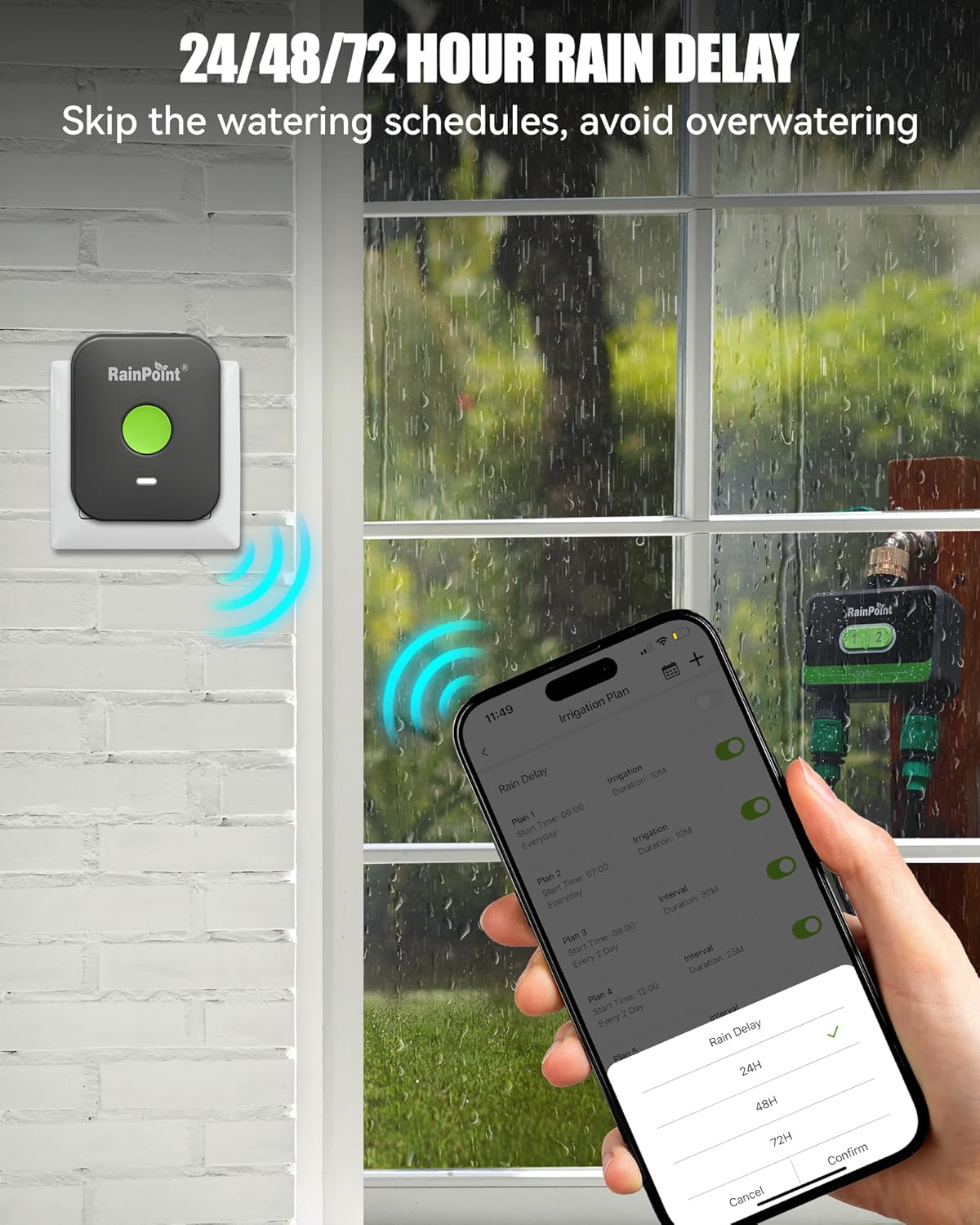
- Weather Adjustment: When weather data indicates rain or low evapotranspiration, the system can skip or reduce watering based on your rules.
- Linkage: If you have several RainPoint timers, Smart Scenes let them act in concert — useful for zoning and staged watering.

Seasonal Adjustment
You’ll find the seasonal adjustment feature reduces repetitive tuning. You can set a percentage adjustment per month (10%–200%) so the controller automatically increases or decreases run times as seasons change. That’s handy if you want less watering in cooler months or more during peak summer.
Voice Control Compatibility
If you use a smart home assistant, you’ll like the Alexa and Google Assistant compatibility. You can use voice commands to start or stop watering and to check system status, making hands-free control easy while you’re carrying tools or plants.
Expandability and System Limits
You can expand your system by pairing multiple timers with the smart hub. For stability, RainPoint recommends adding no more than four irrigation timers per hub. If you’re planning a larger automated setup, consider multiple hubs or a hub with higher capacity.
Practical Performance: Real-World Use
In real-world use, the timer performs reliably for routine watering tasks. You’ll see consistent run times and the app reliably reports status. The brass inlet helps prevent leaks at the supply side, and cycle options mean you can avoid runoff on sloped areas.
- Battery Life: If your model runs on batteries, battery life varies with use and WiFi usage. Expect to check batteries seasonally if you don’t have wired power.
- Leak Prevention: The brass fitting gives a firmer seal; you’ll still want to use a good hose washer for a watertight connection.
Setup Troubleshooting Tips
If you run into setup issues, there are common fixes that usually resolve them quickly:
- WiFi Band: Make sure your phone and hub connect to 2.4 GHz WiFi — 5 GHz is not supported.
- Signal Strength: If the hub can’t reach the timer location reliably, move the hub closer or use a WiFi extender.
- App Permissions: Grant the app necessary permissions on your phone for notifications and background data.
- Reboot Sequence: Power-cycle the hub and timer if pairing stalls; reattempt pairing after waiting 30 seconds.

Best Use Cases and Ideal Users
You’ll find this product especially suitable if you:
- Want an easy-to-use smart hose timer for lawn and garden watering.
- Need independent schedules for two different zones (for example, lawn and planter beds).
- Want weather-aware automation and seasonal adjustments to reduce manual adjustments.
- Use Alexa or Google devices and prefer voice commands for convenience.
- Have a small-to-medium property where a few timers will handle sections of the yard.
Limitations and Considerations
There are a few things you’ll want to keep in mind:
- 2.4 GHz Requirement: If your whole home network is set to 5 GHz only, you’ll need to enable 2.4 GHz or use a separate SSID.
- Hub Limit: The recommendation of up to 4 timers per hub means large estates might need multiple hubs.
- Battery vs. Wired Power: If your model depends on batteries, you’ll have to check and replace them periodically. If you prefer completely hardwired systems, this may not match your needs.
- App Learning Curve: Most users adapt quickly, but if you prefer purely manual mechanical timers, the app will add an extra layer of management.
Comparison with Similar Smart Hose Timers
If you’re comparing this RainPoint model to other smart hose timers, you’ll notice strengths in two-zone control, brass inlet durability, and flexible watering modes. Other brands may offer more zones or different hub capacities, so your choice depends on whether you prioritize device reliability, app features, or system expandability.
- Pros Compared to Competitors: Brass inlet, Smart Scenes, seasonal adjustment, voice assistant support.
- Possible Downsides Compared to Competitors: Hub limit and potential battery dependency.
Cost Considerations
You’ll typically find this unit at a mid-range price point relative to basic mechanical timers and higher-end multi-zone irrigation controllers. Factor in potential additional costs if you need to buy a hub or multiple timers for larger properties.
Maintenance and Longevity
You’ll keep the device operating longer by doing a few simple maintenance tasks:
- Winterize: Disconnect and store indoors if you live in freezing climates to prevent damage.
- Clean Threads and Washers: Ensure a good seal by checking washers and cleaning threads periodically.
- Check Batteries: Replace batteries annually or as needed if your unit uses battery power.
- Firmware Updates: Use the app to install firmware updates that may improve reliability or add features.
Security and Privacy Notes
You’ll want to protect your smart garden system the same way you protect other smart home devices:
- Secure WiFi: Use a strong password and keep firmware updated on your router.
- App Account Security: Use strong, unique passwords and enable any available two-factor authentication.
- Manage Family Access: Only give app access to trusted family members and consider revoking access for temporary guests.
Pros and Cons Summary
You’ll find the following strengths and weaknesses useful when deciding.
Pros:
- Durable brass inlet reduces risk of stripped or leaking connections.
- Two independently programmable zones with up to six schedules per zone.
- Multiple watering modes (Normal, Interval, Cycle & Soak) for flexible control.
- Smart Scenes and weather-based adjustments for hands-off watering.
- Seasonal adjustment (10–200%) automates monthly changes.
- App-based remote control and history logs.
- Voice control via Alexa and Google Assistant.
- Expandable system for a small network of timers.
Cons:
- Requires 2.4 GHz WiFi — no 5 GHz support.
- Recommended hub limit of 4 timers — may need additional hubs for large properties.
- Battery models need occasional battery replacement.
- App features may have a learning curve for non-tech users.
Real User Scenarios and Examples
You’ll find the RainPoint timer useful in many real-life setups:
- Small Lawn + Flower Beds: Use Zone 1 for lawn with longer normal irrigation cycles and Zone 2 for flower beds with Cycle & Soak to prevent runoff.
- Vacation Scheduling: Set every 2–7 day intervals while you’re away, combined with weather-based skip rules to avoid overwatering.
- Raised Beds and Pots: Use interval mode for controlled, short bursts that drip systems prefer, avoiding waterlogged soil.
- Staged Watering for Slopes: Use cycle & soak to allow absorption and prevent water rushing downhill.
Frequently Asked Questions (FAQ)
You’ll likely have questions; here are answers to the most common ones.
- Do I need the hub? The hub improves stability and enables linking multiple timers. Some basic remote features might work without it, but the hub is recommended for full functionality.
- Can I use this with drip irrigation? Yes — the Cycle & Soak and interval modes are particularly useful for drip systems.
- What happens in a power outage? If your timer runs on batteries, it should continue to operate; if it’s hub-dependent and the hub loses power, remote control will be interrupted until power or connection is restored.
- How many schedules can I set? Up to 6 watering schedules per zone, giving you plenty of customization.
Tips to Get the Best Results
You’ll get the most from the RainPoint timer if you follow a few practical tips:
- Place the hub within good range of the timer location to avoid signal dropouts.
- Use the seasonal adjustment to reduce frequent schedule reprogramming.
- Start with conservative durations and monitor soil moisture to avoid overwatering.
- Use Cycle & Soak on slopes or compacted soils to allow better absorption.
- Test voice commands once you’ve linked the controller to your assistant to confirm proper phrasing.
Final Recommendation
If you want a friendly, capable smart hose timer with solid hardware like a brass inlet, flexible scheduling, and smart features that actually save you time, this RainPoint WiFi Water Timer for Garden Hose with Brass Inlet, 2-Zone Smart Hose Timer, WiFi Irrigation Controller, Automatic Sprinkler Watering System for Lawns and Yard is a strong choice. It’s particularly effective for small-to-medium yards where two independently controlled zones cover most needs. The app-based control, seasonal adjustments, and voice assistant compatibility make it convenient and practical for everyday gardening.
If your property is very large or requires many zones, you’ll want to plan for multiple hubs or consider a full-fledged multi-zone irrigation controller. For typical homeowners who prefer a straightforward, modern, and smart approach to watering, this device will likely make your life easier and help you keep your lawn and garden healthier with less fuss.
If you want, I can walk you through step-by-step setup instructions for your particular faucet configuration, or help design a watering schedule for your lawn type and local climate. Which would you prefer?

Disclosure: As an Amazon Associate, I earn from qualifying purchases.