
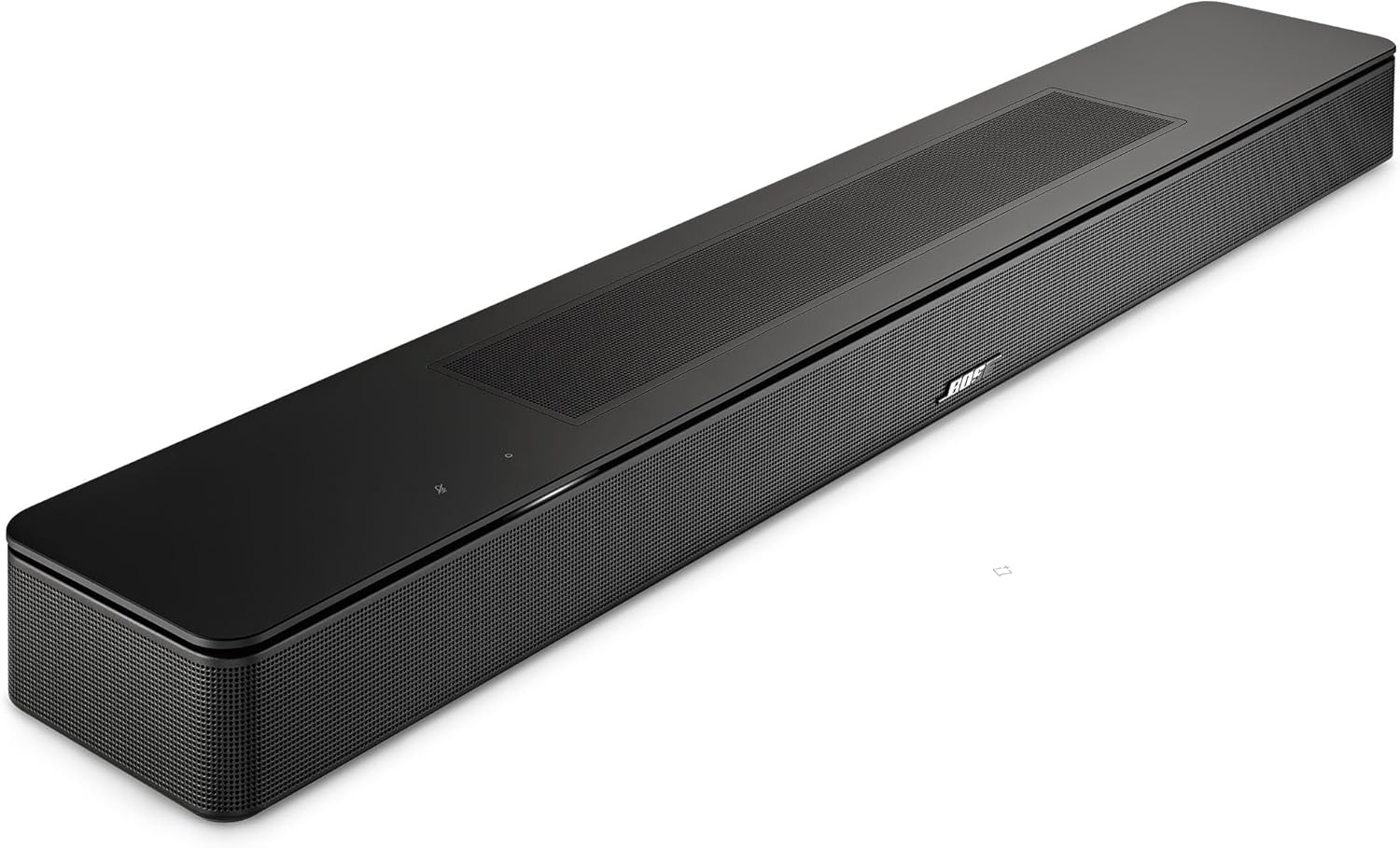
Looking for a compact soundbar that can actually make your movies, shows, and music feel cinematic?

Buy The Bose Smart Dolby Atmos Soundbar On Amazon
Product overview: Bose Smart Dolby Atmos Soundbar, All-in-One Soundbar for TV, A.I. Dialogue Mode, Voice Control and Amazon Alexa Built-in, Supports Bluetooth/AirPlay/Spotify Connect/Chromecast, Black
This model brings Bose’s latest on-device processing in a small package designed to fit under most TVs without taking over your living room. You’ll see features like Dolby Atmos, Bose TrueSpace upmixing, A.I. Dialogue Mode, and built-in Amazon Alexa listed front and center — and the soundbar mostly lives up to those promises in day-to-day use.
What the product promises and what that means for you
Bose markets this soundbar as “total immersion, for everything you play,” and that’s intentional: it tries to give you theater-like surround sensation from one compact enclosure. Practically speaking, that means it uses upward-firing transducers and signal processing to create height and width in the soundstage so you feel audio above and beyond your TV’s speakers. You should also see clearer voices, simplified streaming options, and hands-free voice control if you lean on Alexa.
Bose Smart Dolby Atmos Soundbar, All-in-One Soundbar for TV, A.I. Dialogue Mode, Voice Control and Amazon Alexa Built-in, Supports Bluetooth/AirPlay/Spotify Connect/Chromecast, Black
$399 In Stock
Quick specs and feature breakdown
Below is a compact table to help you scan the main specs and features quickly. This gives you a clearer idea of what’s built in and what you’ll need to add separately.
| Feature | Detail |
|---|---|
| Form factor | Compact all-in-one soundbar |
| Channels | Dolby Atmos support with virtualized height (proprietary upmixing) |
| Transducers | Five transducers including two upward-firing drivers |
| Technology highlights | Bose TrueSpace upmixing, A.I. Dialogue Mode |
| Voice assistant | Amazon Alexa built-in; Bose Voice4Video for TV/cable control |
| Streaming | Bluetooth, Apple AirPlay 2, Spotify Connect, Chromecast built-in |
| Connections | HDMI eARC, optical (depending on model), Wi‑Fi |
| Remote/App | Physical remote included; Bose Music app for setup and control |
| Color | Black |
| Optional extras | Pair with Bose Ultra Open Earbuds as rear surrounds (sold separately) |
| Ideal room size | Small to medium living rooms; desktop setups |
How to read this table for your needs
Use the table to see if the soundbar has the connections and streaming options you rely on. If you need multi-room integration, check the app features; if you rely on Alexa or Chromecast, those are both supported natively here. This gives you an immediate yes/no for compatibility with your current gear.
Design and build
The Bose Smart Dolby Atmos Soundbar keeps the aesthetics minimal and polished so it blends with most modern TVs and living spaces. The grille wraps around the front and top, and the finish is a subtle matte black that won’t attract fingerprints.
Size and placement considerations
Because it’s compact, you can place it directly under most TVs without blocking the IR sensor or screen. If your TV sits on a very low stand, you may need to check angle and clearance, but Bose has designed it so the upward-firing drivers still get room to project their effect in typical setups.
Materials and feel
The soundbar feels solid in-hand and doesn’t rattle when you press on the housing. Buttons are minimal; most interaction will be through the included remote, the touch controls, or the app. The build quality aligns with Bose’s reputation for premium-feeling consumer audio.
Setup and user interface
Setting this soundbar up is straightforward, and you’ll have multiple ways to control it: remote, voice, and the Bose Music app. The app guides you through Wi‑Fi setup, linking to streaming services, and optional firmware updates.
Out-of-the-box experience
You’ll unbox, plug into HDMI eARC (recommended), and run the setup wizard in the Bose Music app. The software detects your TV and prompts for permissions for Alexa if you want voice configuration. Most users should be up and running within 10–15 minutes.
App and remote usability
The Bose Music app offers EQ presets, basic leveling, and streaming integration. The physical remote is simple and easy to use, with dedicated buttons for voice assistant and input switching. If you prefer voice control, Alexa built-in lets you play music and control smart home devices without picking up the remote.
Connectivity and streaming
You get a range of modern streaming protocols: Bluetooth, AirPlay 2, Spotify Connect, and Chromecast built-in. That gives you flexibility whether you’re on iPhone, Android, or a laptop.
Wireless options and reliability
Bluetooth works fine for casual listening, but for best audio and multi-room use, use Wi‑Fi-based streaming (AirPlay, Chromecast). Streaming over Wi‑Fi is stable in most home networks; the Bose app also handles device switching smoothly so you can move from phone to laptop playback easily.
Physical connections for the TV
HDMI eARC is the recommended connection because it passes high-bitrate audio formats and enables the TV to send Dolby Atmos or Dolby Digital Plus to the bar. If your TV lacks eARC, optical still works but with limitations on Atmos passthrough. Make sure your TV settings are set to bitstream or Passthrough for surround formats.
Sound performance — Atmos and TrueSpace
This soundbar is engineered to give you an immersive soundstage heavier than its size would suggest. Bose TrueSpace technology upmixes stereo and 5.1 signals to create a multi-channel effect, and the two upward-firing drivers aim to create height for Dolby Atmos content.
How Dolby Atmos feels on this bar
You’ll notice a sense of height and spaciousness on Atmos-enabled content, particularly with movies that mix sounds above the listening plane. Objects that pan overhead will have a convincing sense of movement, though you shouldn’t expect the three-dimensional precision of a full multi-speaker Atmos setup. For most viewers, though, the effect is impressively theatrical given the single cabinet.
TrueSpace upmixing for non-Atmos content
One of the best surprises is how well TrueSpace makes stereo music and older surround formats sound bigger. When you play 2.0 or stereo TV content, the soundstage widens and elements that were previously glued to the TV feel more spacious. This is especially helpful for broadcast TV, streaming shows, and music videos where native Atmos is absent.

Dialogue clarity and A.I. Dialogue Mode
If you watch a lot of dialogue-heavy content — dramas, news, talk shows — A.I. Dialogue Mode is designed to make speech intelligible without sacrificing immersion.
What A.I. Dialogue Mode does for you
The soundbar uses onboard processing to separate vocal frequencies from background effects and then rebalances them for clarity. You won’t have to crank volume during quiet dialogue or blast the TV during loud action scenes. The mode is effective at reducing listener fatigue during long viewing sessions.
When to use and when to avoid it
Use A.I. Dialogue Mode for content where speech is the focus. For music or scenes where the director intended a precise mix, you might prefer turning it off to preserve the original balance. There’s a small trade-off where the mode can make dialogue sound slightly forward, but most users prefer intelligibility over perfect purism in everyday viewing.
Bass, dynamics, and low-end performance
Given the compact size, bass isn’t earth-shaking, but the soundbar provides a tight and controlled low end that supports action and music.
Punch and extension
You’ll get satisfying punch for explosions and basslines, but if you crave physical chest-thumping low frequencies, you’ll want to add a subwoofer. The soundbar remains articulate and avoids muddiness, which is a positive for mixed content.
Adding a subwoofer or surrounds
Pairing a dedicated subwoofer will fill out the bottom octaves and give movies more visceral impact. The Bose ecosystem can integrate optional wireless subwoofers and rear speakers, or you can use compatible third-party subs if you need more rumble.
Stereo imaging and soundstage
The combination of front-firing and upward-firing drivers produces a soundstage that feels wider and taller than the bar’s dimensions.
Imaging for music and films
Music tracks enjoy a wider spread with instruments positioned convincingly across the stage, and film sound effects gain improved spatial placement. While you won’t get the pinpoint accuracy of discrete surround speakers, the sense of depth and separation is well above average for a single-bar solution.
Listening positions and sweet spots
You’ll get the best effect when you’re seated centrally and a few feet away from the TV. The Atmos height effect is less consistent off to the sides, but the sound still remains enjoyable across a typical couch area.

Voice control and Amazon Alexa
The Bose Smart Dolby Atmos Soundbar includes Amazon Alexa built in, so you can use voice commands to play music, control smart home devices, or adjust volume hands-free.
Alexa performance and privacy
Alexa responds reliably for common tasks and integrates with devices you already have in the Amazon ecosystem. You can mute the microphone for privacy or use the app to manage permissions and voice recordings. Voice4Video expands Alexa’s capabilities to control your TV and cable/satellite box by voice, which can be a big convenience if you regularly switch channels or sources.
Limitations and practical use
Voice detection is solid in quiet rooms but can struggle if there’s loud ambient noise or the TV is blasting. If you sit far away, the sensitivity drops — in those cases, the remote and app remain fast and reliable alternatives.
App, firmware updates, and ecosystem
The Bose Music app is your hub for setup, firmware updates, and streaming service integration.
What the app lets you do
You can manage soundbar settings, run updates, link streaming services, and group compatible Bose speakers for multi-room playback. Firmware updates are straightforward and can add new features or improve performance over time.
Multi-room and ecosystem compatibility
If you already own Bose products, this soundbar fits into that ecosystem and makes multi-room playback easy. It also supports Chromecast and AirPlay 2, allowing you to mix devices from other ecosystems in many scenarios.
Pairing with extras: earbuds and rear speakers
A unique Bose suggestion is to pair the soundbar with the Bose Ultra Open Earbuds (sold separately) to serve as rear surrounds for a more personal surround experience.
How the earbuds work as surrounds
When paired, the earbuds act as wireless rear channels, giving you real surround separation if you’re the primary listener. This is a creative, space-saving solution if you don’t want to install physical rear speakers.
Practicality and limitations
The idea is excellent for single viewers or couples, but it isn’t ideal for a full-family setup where everyone wants to hear the surround effects. Battery life and potential Bluetooth latency are additional things to weigh before relying on earbuds as permanent rear speakers.
Comparisons: how it stacks up against alternatives
If you’re deciding between similarly priced compact soundbars, here’s how this Bose model typically compares.
Bose vs. Sonos Beam (Gen 2)
Both aim for compact, high-quality home theater sound. The Sonos Beam Gen 2 has good Atmos virtualization and excels in deep integration with Sonos’ ecosystem; the Bose tends to produce a slightly richer, more spacious sound with TrueSpace upmixing, and includes Alexa built in. If you prioritize broader streaming options and an immersive soundstage from a single enclosure, Bose has the edge.
Bose vs. Samsung HW-Q-series
Samsung’s Q-series often emphasizes power and TV integration with Samsung sets, and their Q-series sometimes includes subwoofer bundles. Bose delivers cleaner voice clarity and a more compact design. If you want bigger, punchier bass out of the box, Samsung models with included subwoofer packages might be preferable. If you want crisp dialogue and refined spatial processing, Bose is attractive.
Pros and cons
This quick pros/cons snapshot helps you weigh the decision at a glance.
| Pros | Cons |
|---|---|
| Impressive immersive sound for its size with Dolby Atmos and TrueSpace | Bass is limited compared to systems with dedicated subwoofers |
| A.I. Dialogue Mode greatly improves speech clarity | Atmos virtualization can’t fully match a discrete multi-speaker setup |
| Multiple streaming options (AirPlay 2, Chromecast, Spotify Connect, Bluetooth) | Price-to-feature ratio may be high for budget-conscious buyers |
| Built-in Amazon Alexa and Voice4Video functionality | Upward-firing drivers rely on room acoustics for best effect |
| Sleek, compact design that fits most setups | Extra rear/surround options cost more (earbuds or speakers sold separately) |
How to interpret these pros and cons
If you prioritize speech clarity, compact design, and a convincing virtual surround without wiring up multiple speakers, the pros outweigh the cons. If you prioritize raw low-frequency impact or have a large, open plan room, plan on adding a subwoofer.
Best use cases and who should buy this
This soundbar is aimed at people who want a major uplift from TV speakers without committing to a full surround setup. It’s well-suited for apartments, small to medium living rooms, bedrooms, and desktop multimedia setups.
Ideal buyer profiles
- You watch a lot of streaming movies and want a more cinematic sound without a bulky system.
- You regularly struggle to hear dialogue on TV and want clearer voices without constantly changing volume.
- You use smart assistants and want Alexa integrated into your audio system.
- You want modern streaming flexibility (AirPlay, Chromecast, Spotify Connect).
When to choose something else
If you want enormous bass and room-filling volume, or you already plan a full 5.1/7.1+ Atmos speaker layout now or in the future, a modular system with separate speakers and subwoofer might be a better long-term investment.
Tips for getting the best performance
Room setup and small adjustments can make a big difference in perceived immersion and clarity.
Placement and positioning tips
Place the soundbar centered under the TV and avoid blocking the upward-firing drivers. Aim for a listening position that’s a few feet from the screen and slightly centered to maximize height effects. Hard ceilings and reflective surfaces help the Atmos virtualization; very high or sloped ceilings reduce the effect.
Settings and tweaks
Use HDMI eARC for best audio fidelity. Turn on A.I. Dialogue Mode for talk-heavy content and switch it off for carefully mixed films or music. Check your TV audio output settings and enable bitstream/passthrough when possible to preserve surround formats.
Common issues and troubleshooting
You may run into a few common scenarios; most are easily fixed.
No Atmos or limited surround
If Dolby Atmos content isn’t passing through, check that your TV is set to output bitstream and that the HDMI connection is on the eARC port. Some TVs may need firmware updates to correctly hand off Atmos to external devices.
Alexa responsiveness problems
If Alexa isn’t responding, check privacy settings and whether the microphone is muted. Network congestion or a weak Wi‑Fi signal can also hinder cloud-based voice services.
Streaming dropouts
If Wi‑Fi streaming stutters, try restarting your router, using the app to prioritize the device, or switching to 5 GHz Wi‑Fi if available. Wired Ethernet connections (if supported by the soundbar or via a connected TV) offer the most stable streaming.
Value and pricing considerations
This soundbar sits in the premium compact soundbar tier. You’re paying for Bose’s processing, brand reputation, and thoughtful features like A.I. Dialogue Mode and TrueSpace. Whether that price is worth it depends on how much you value compact design and built-in voice control versus buying separates for better raw power.
Long-term value
Firmware updates and the ecosystem approach mean the soundbar can gain features over time and remain current. If you plan on expanding inside the Bose ecosystem, the initial investment can feel more justified.
Final verdict
You get a polished, compact soundbar that punches above its weight for immersion, clarity, and smart features. The Bose Smart Dolby Atmos Soundbar is a strong choice if you want a neat, high-quality upgrade from TV speakers with excellent dialogue enhancement and broad streaming support.
Bottom line for your decision
If you want an all-in-one, stylish sound upgrade with reliable voice control and convincing virtual Atmos in a small footprint, this Bose soundbar will likely satisfy you. If you demand basement-rattling bass or a fully discrete Atmos array, plan on pairing it with a subwoofer or choosing a modular system instead.
Frequently asked questions (FAQs)
Below are quick answers to common questions you might have before buying.
Will this soundbar work with my non-Alexa smart home?
Yes. You can use the soundbar without Alexa or use other streaming methods like AirPlay and Chromecast. The soundbar’s core audio features don’t require voice control.
Do I need a special HDMI cable for eARC?
No special “Atmos” cable is required, but use a high-quality HDMI cable rated for high-speed or HDMI 2.1 to ensure reliable eARC connectivity.
Can you add a wireless rear speaker?
Yes, you can add compatible Bose wireless speakers or use the Ultra Open Earbuds as a rear solution as suggested by Bose. They are sold separately and add genuine surround presence.
Is it worth buying over a cheaper generic soundbar?
If you value dialogue clarity, refined soundstage, and a polished user experience with voice assistants built in, the extra cost is often worth it. Cheaper bars might offer louder output but usually lack the same processing and finish.
If you want more details about a specific use case — for example, pairing this soundbar with a particular TV model, adding a subwoofer, or tuning room-specific settings — tell me your room size and TV model and I’ll give tailored advice.
Disclosure: As an Amazon Associate, I earn from qualifying purchases.