
Are you ready to upgrade your home’s comfort and save on energy without losing control?

ecobee Smart Thermostat Enhanced – First impressions
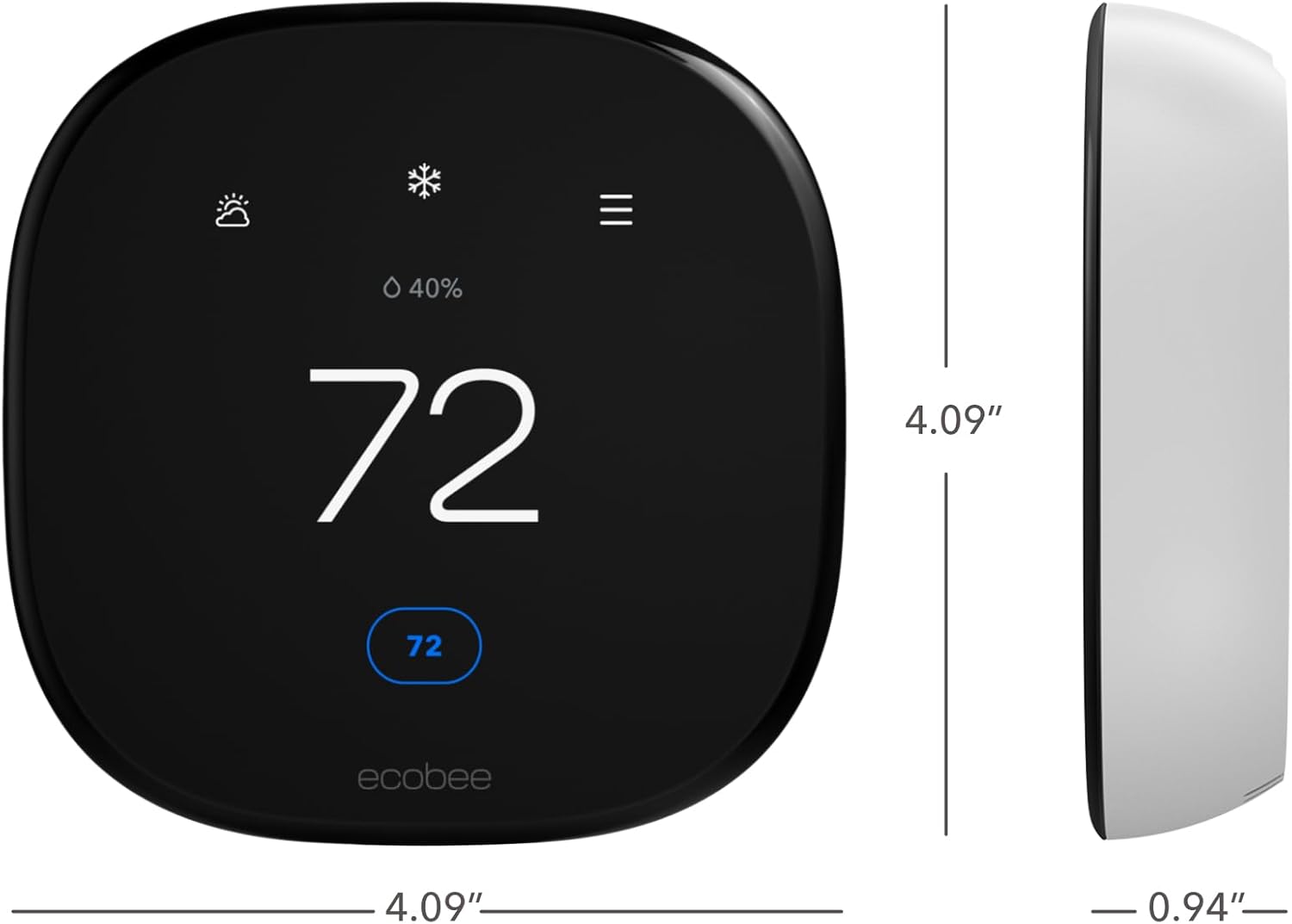
You’ll notice the ecobee Smart Thermostat Enhanced – Programmable Wifi Thermostat – Works with Siri, Alexa, Google Assistant – Energy Star Certified – Smart Home right away with its sleek touchscreen and modern design. It looks like a premium device on your wall, and the packaging includes the Power Extender Kit (PEK) and Trim Kit so you don’t need extra parts for most installs.
You’ll appreciate that it’s Energy Star certified and promises significant savings. The unit balances smart automation with manual control, so you’re not forced into a single mode of operation.
What’s in the box
You’ll find everything necessary for a DIY installation:
- ecobee Smart Thermostat Enhanced unit
- Power Extender Kit (PEK)
- Trim Kit for neat installation
- Mounting screws and wire labels
- Quick start guide and documentation
Having the PEK included is especially helpful if your home lacks a dedicated C (common) wire, which often complicates smart thermostat installs.

ecobee Smart Thermostat Enhanced - Programmable Wifi Thermostat - Works with Siri, Alexa, Google Assistant - Energy Star Certified - Smart Home
$199.99 In Stock
Key features at a glance
You’ll want to know what makes this model stand out. This thermostat combines remote sensing, occupancy detection, learning algorithms, and voice assistant compatibility into one product.
It’s designed to:
- Save up to 26% annually on heating and cooling vs. a fixed 72°F hold
- Automatically adjust when you’re away
- Preheat or precool using built-in radar occupancy
- Learn preferences and schedules over time
- Work with Siri, Alexa, and Google Assistant
These features together give you a device that both reacts to your immediate needs and optimizes for efficiency over time.
Quick spec table
Here’s a simple breakdown to help you compare specs quickly.
| Feature | Details |
|---|---|
| Model | ecobee Smart Thermostat Enhanced |
| Compatibility | Works with most 24 VAC HVAC: gas, oil, electric, dual fuel, forced air (2H/2C), heat pump (3H/2C), boilers |
| Power | Hardwired; includes Power Extender Kit for homes without C wire |
| Occupancy sensing | Built-in radar occupancy, optional SmartSensors for room-level detection |
| Voice assistants | Siri, Alexa, Google Assistant |
| Energy savings | Up to 26% per year (vs. 72°F hold) |
| Connectivity | Wi-Fi; ecobee app (smartphone, tablet, Apple Watch) |
| Certifications | Energy Star Certified |
| Box contents | Thermostat, PEK, Trim Kit, mounting hardware, guide |
This table gives you a quick snapshot so you can check compatibility and core features at a glance.
Installation: What you need to know
You’ll likely be able to install the thermostat yourself if you’re comfortable with basic wiring and using a screwdriver. ecobee ships the Power Extender Kit so you don’t have to hunt for a C wire in many homes.
The included instructions are clear, and the app provides step-by-step guidance during setup. However, if your HVAC system is less common or you’re not comfortable with wiring, you might prefer professional installation.
Installation steps (concise)
You’ll follow these general steps during install:
- Turn off power to your HVAC at the breaker.
- Remove your old thermostat and label wires.
- Mount the ecobee backplate and connect wires (or install PEK at furnace if no C wire).
- Attach the thermostat and restore power.
- Complete setup in the ecobee app and run compatibility checks.
The PEK is installed at the furnace control board, which is straightforward for most homeowners but may be better handled by a technician if you’re unsure.

Compatibility and system support
You’ll want to check compatibility because the thermostat supports a wide range of HVAC setups but not every single system out there. ecobee claims compatibility with 90% of systems and provides a Compatibility Checker on their support page.
If your system is a conventional forced-air setup, heat pump, or boiler, you’re likely fine. Multi-stage systems and older or unique control schemes may need extra attention.
Systems supported
You’ll find support for:
- Gas, oil, and electric systems
- Forced air conventional systems (2H/2C)
- Heat pumps (3H/2C)
- Boilers and dual-fuel setups
If in doubt, use the compatibility checker or consult a pro. Installing on an unsupported system could cause errors or incomplete functionality.
Energy savings and efficiency
You’ll be interested in savings: ecobee states up to 26% annual savings on heating and cooling compared to a steady 72°F hold. The savings come from intelligent scheduling, occupancy-based adjustments, and remote control that avoids conditioning an empty home.
The thermostat learns your temperature preferences and adapts, which helps avoid wasteful heating or cooling. Energy reports in the app make it clear where savings occur and allow you to fine-tune behavior.
How savings are achieved
You’ll notice energy savings through:
- Auto-away adjustments when no one is present
- Learning schedules to reduce runtime
- Integration with SmartSensors to condition only occupied rooms
- Humidity-aware adjustments to increase comfort at lower energy cost
These combined behaviors reduce runtime without meaningfully affecting comfort for most households.
Sensors and occupancy detection
You’ll find two forms of occupancy awareness: built-in radar occupancy and optional remote SmartSensors. The radar sensor detects presence near the thermostat and can preheat or precool when you’re approaching the home.
SmartSensors detect which rooms are occupied and feed that data back to the thermostat for better whole-home comfort — so bedrooms aren’t over-conditioned while living areas are used.
SmartSensors: room-level control
You’ll be able to add ecobee SmartSensors (sold separately) to detect motion and temperature in rooms away from the thermostat. This helps eliminate hot or cold spots in the house by prioritizing occupied rooms.
If you want consistent comfort in different rooms at different times of day, adding a few sensors is a smart move.

Built-in radar occupancy and preconditioning
You’ll notice the built-in radar isn’t just for telling the unit when someone is home; it’s used to preheat or precool before you arrive. That means your home can reach the desired temperature right when you walk in, not minutes later.
This intelligent behavior relies on presence detection plus historical patterns to anticipate arrival times and adapt dynamically.
How preconditioning works
You’ll see the thermostat:
- Detect when you’re away and reduce conditioning
- Recognize returning presence patterns
- Use radar to detect approach and begin conditioning early
This feature is especially useful if you want comfort upon arrival without constantly keeping the system running.
App, scheduling, and learning capabilities
You’ll control the thermostat via the ecobee app on your phone, tablet, or Apple Watch. The app provides scheduling tools, energy reports, and remote control. The thermostat learns your preferences and schedule to minimize manual adjustments over time.
You’ll also be able to set specific hold temperatures for special situations and override the learned schedule when needed.
Scheduling and learning
You’ll benefit from:
- A simple scheduling interface to set wake, away, sleep, and home modes
- Adaptive learning that refines schedules based on your adjustments
- Automatic adjustments for humidity and occupancy
This hybrid approach gives you both automation and direct control, depending on how hands-on you want to be.
Voice assistants and smart home integration
You’ll appreciate that the device works with Siri, Alexa, and Google Assistant, so you can use voice commands from your phone, smart speaker, or other devices. It also integrates with many smart home ecosystems for coordinated automation.
If you’re invested in a platform like Apple HomeKit or Amazon Alexa routines, the ecobee integrates smoothly and lets you include thermostat actions in scenes and routines.
Examples of voice and automation
You’ll be able to:
- Say “Hey Siri, set temperature to 72°” or use Alexa/Google commands
- Include climate control in home/away or sleep scenes
- Control the thermostat through routines triggered by sensors or geofencing
That flexibility makes it easy to automate comfort around your lifestyle.

Power Extender Kit (PEK) and Trim Kit
You’ll be relieved the PEK is included. Homes without a C wire often have trouble powering advanced thermostats; the PEK resolves that by providing the required common connection at the furnace or HVAC control board.
The Trim Kit cleans up the wall appearance where the old thermostat left paint or holes, producing a professional-looking install.
Why the PEK matters
You’ll gain:
- Simple retrofit capability in many older homes
- Avoidance of battery reliance or additional wiring jobs
- A neater installation that maintains full functionality
If you’re comfortable with basic furnace-side wiring, the PEK installation is straightforward and usually takes only a few minutes.
Display, controls, and user experience
You’ll find the touchscreen bright, responsive, and easy to navigate. The UI is clean and intuitive, with large icons and straightforward menus for manual overrides and quick changes.
Physical controls are minimal since the touch interface handles most actions, and the ecobee app mirrors many on-device features so you can control things remotely.
Daily use impressions
You’ll enjoy:
- Quick temperature changes via touch or app
- Clear status screens for current temp, setpoint, humidity, and occupancy
- Smooth transitions between automatic and manual modes
Overall, the daily user experience feels polished and modern.
Maintenance and reliability
You’ll appreciate that the thermostat is hardwired so you won’t replace batteries. Reliability depends on network stability for advanced features, but basic HVAC control remains local even if Wi-Fi is unavailable.
ecobee has a track record of stable hardware and software updates that add features and fix bugs over time.
What to expect long-term
You’ll likely experience:
- Minimal maintenance because the unit is hardwired
- Firmware updates that improve performance
- Continued compatibility with major smart home platforms
If your Wi-Fi drops occasionally, your thermostat still maintains core HVAC control locally.
Troubleshooting common issues
You’ll sometimes encounter connectivity hiccups or compatibility questions. Most issues can be resolved with the app’s diagnostic tools, the compatibility checker, or a quick check of wiring and PEK installation.
ecobee support and online community forums are helpful resources if you run into unusual problems.
Quick fixes you can try
You’ll resolve many problems by:
- Verifying wiring and PEK placement
- Rebooting the thermostat (power cycle at the breaker)
- Reinstalling the ecobee app and re-linking the device
- Checking HVAC system compatibility on the ecobee support page
If a problem persists, contacting ecobee support is the next step — they’re usually responsive and experienced with HVAC specifics.
Security and privacy considerations
You’ll want to know how your data is handled. ecobee uses standard security practices for cloud connections and app communication, including encryption, and gives you the tools to manage account access and integrations.
If privacy is a priority, consider what voice assistants and integrations you enable because those platforms may process additional data outside ecobee’s control.
How to protect your data
You’ll keep things secure by:
- Using strong passwords and enabling two-factor authentication if available
- Reviewing third-party integrations and permissions
- Updating firmware and app regularly to ensure security patches are applied
Being mindful of linked services like Alexa or Google Assistant helps you control what data is shared.
Comparing ecobee Smart Thermostat Enhanced to other models
You’ll want to compare against competitors such as Nest, Honeywell, and other ecobee models. The ecobee stands out for included PEK, SmartSensor support, and radar occupancy features.
Compared to Nest, you’ll get more explicit multi-room sensing options (with sensors sold separately) and a stronger focus on direct integration with a broader set of HVAC systems. Nest tends to emphasize self-learning behavior and design simplicity.
Key comparison points
You’ll consider:
- Compatibility breadth (ecobee often supports more HVAC types)
- Sensor ecosystem (ecobee SmartSensors give room-level data)
- Included accessories (PEK included with ecobee)
- Voice and smart home integration parity (both support major assistants)
Your choice should consider your HVAC type, desire for room sensing, and whether included PEK matters for your installation.
Who should buy this thermostat?
You’ll benefit most if you:
- Want reliable energy savings without micromanaging settings
- Don’t have a C wire and want the PEK included
- Use multiple smart home platforms or voice assistants
- Want room-level comfort with optional SmartSensors
- Appreciate a hardwired device to avoid battery replacements
If you live in a small apartment with simple HVAC and don’t care about sensors or advanced automation, a basic smart thermostat might suffice, but ecobee still offers value.
Who might want a different option
You’ll consider alternatives if you:
- Prefer a thermostat with deeper Nest-specific integrations
- Want a cheaper basic Wi-Fi thermostat without sensors or PEK
- Have an uncommon or proprietary HVAC control system
For most mainstream homes, this model strikes a strong balance of features and compatibility.
Costs and value proposition
You’ll pay more than a basic Wi-Fi thermostat, but the included PEK, sensor ecosystem, radar occupancy, and multi-platform support justify the extra cost for many households. Factor in the potential annual 26% energy savings when evaluating ROI.
With energy savings and improved comfort, many users see the thermostat pay back some of its cost over a few years.
How to estimate your savings
You’ll estimate savings by:
- Comparing current usage to projected savings (ecobee’s 26% is a benchmark vs. 72°F hold)
- Using energy reports in the app to track improvements
- Factoring in local energy rates and heating/cooling load
Actual savings vary, but the combination of automation, occupancy detection, and remote control tends to reduce unnecessary runtime.
Practical tips for best performance
You’ll get the best results if you:
- Place SmartSensors in rooms you use most for accurate detection
- Use the app’s scheduling tools to teach the thermostat your routine
- Keep firmware updated for new features and bug fixes
- Use geofencing or presence detection in the app to trigger away modes
These small steps improve both comfort and efficiency.
Sensor placement recommendations
You’ll get better room balance by:
- Placing sensors at typical human height in frequently used rooms
- Avoiding direct sunlight, vents, or very drafty areas
- Keeping at least one sensor in the main living area and one in a frequently used bedroom
Strategic placement allows the thermostat to prioritize occupied spaces and smooth out temperature differences.
Frequently asked questions (short)
You’ll probably have questions; here are common ones.
Q: Do I need a C wire?
A: Not necessarily — the included PEK handles houses without a C wire in many cases, but check compatibility.
Q: Can I control it without Wi-Fi?
A: Basic thermostat functions continue locally, but app features and remote control require Wi-Fi.
Q: Are SmartSensors included?
A: No — SmartSensors are optional accessories for room-level detection.
Q: Does it work with heat pumps and boilers?
A: Yes — it supports most conventional, heat pump, and boiler systems (check compatibility).
Final verdict
You’ll find the ecobee Smart Thermostat Enhanced – Programmable Wifi Thermostat – Works with Siri, Alexa, Google Assistant – Energy Star Certified – Smart Home to be a strong, flexible, and well-supported smart thermostat. It combines intelligent automation, broad compatibility, and useful accessories like the included PEK to simplify installation.
If you want better comfort control, automated savings, and seamless integration with voice assistants and smart home platforms, this ecobee model gives you those capabilities with minimal fuss.
Bottom line
You’ll get a feature-rich thermostat that’s easy to install, intelligently manages comfort and efficiency, supports most HVAC systems, and integrates with your digital home — a solid long-term investment for most households.

Disclosure: As an Amazon Associate, I earn from qualifying purchases.