
Are you looking for a reliable underfloor heating kit that gives you warm tile floors, precise control, and long-term warranties without a steep learning curve?

Product Overview: LuxHeat 40sqft Electric Radiant Floor Heating System – 120v Underfloor Heating System – Includes UDG4 Programmable Thermostat w/GFCI, Heat Cable, Uncoupling Membrane for Under Tile, Sensor & Alarm
You’re reading about a full kit designed to make installing electric radiant floor heating straightforward for a single room. The LuxHeat 40sqft Electric Radiant Floor Heating System combines heating cable, a high-performance uncoupling membrane, and a programmable thermostat with integrated safety features to deliver a turnkey under-tile solution.
What this kit includes
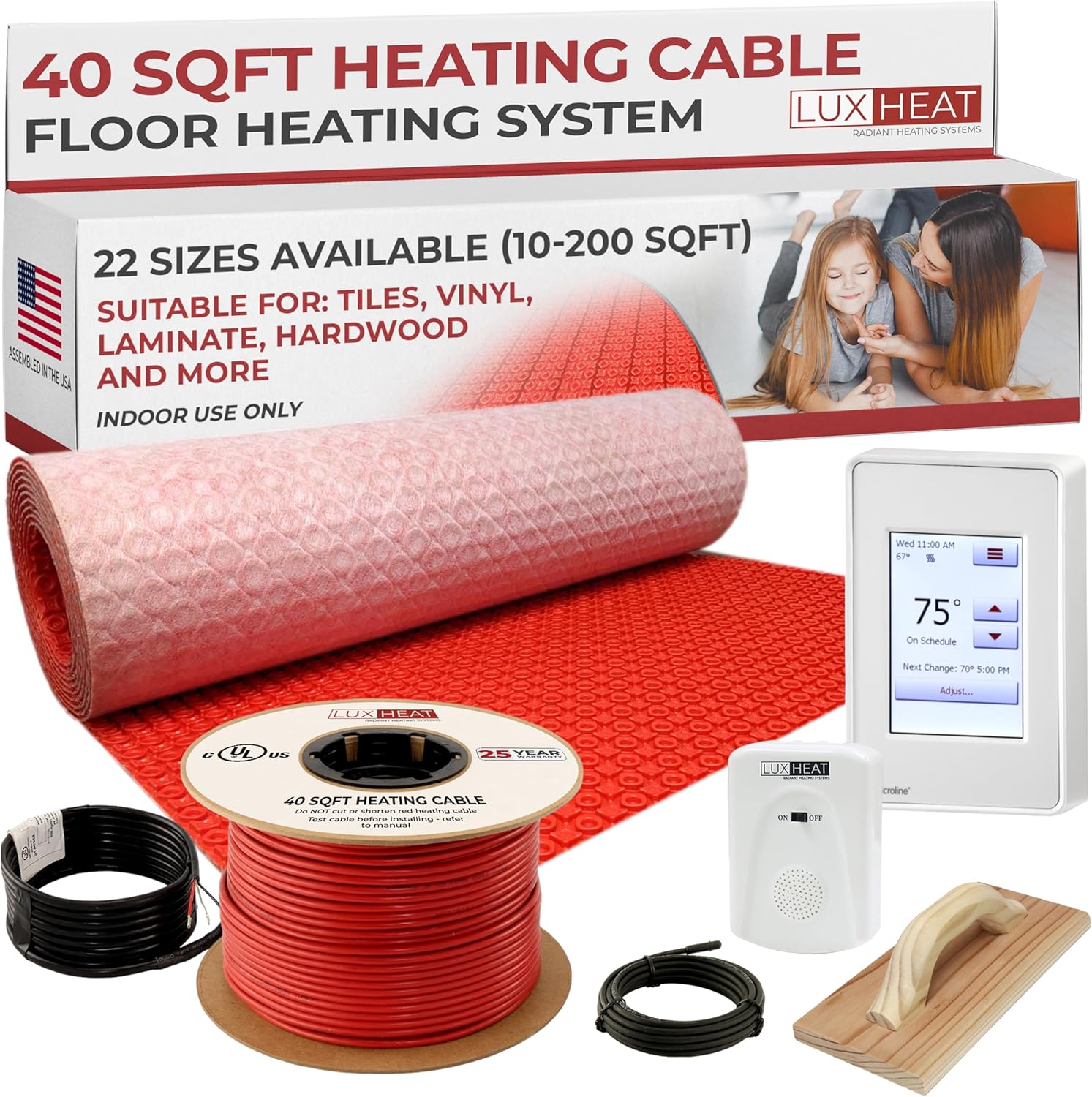
You get a complete kit assembled for a 40 sq ft coverage area so you won’t be hunting for components. The package arrives with the heat cable, Prova Flex-Heat uncoupling membrane, UDG4 touchscreen thermostat (with integrated GFCI), a floor sensor, an alarm, and a wood float to aid membrane installation.
LuxHeat 40sqft Electric Radiant Floor Heating System - 120v Underfloor Heating System - Includes UDG4 Programmable Thermostat w/GFCI, Heat Cable, Uncoupling Membrane for Under Tile, Sensor & Alarm
Technical Specifications
This table gives you a quick breakdown of the key numbers and specs so you can compare them with your project requirements. These specs also help you plan circuit capacity, layout, and materials.
| Item | Specification |
|---|---|
| Cable coverage | 40 sq ft (at 3 in spacing) |
| Cable length | 160 ft |
| Voltage | 120 V |
| Current draw | 4.0 A |
| Power output | 480 W (12 W/sq ft) |
| Thermostat model | UDG4-4999 (touchscreen programmable) |
| Thermostat features | Integrated Class A GFCI, dual sensing (air/floor), power logging, child lock, self-learning, 7-day/4-event schedule |
| Membrane brand | Prova Flex-Heat Uncoupling Membrane |
| Membrane size | 3.24 ft x 15.4 ft (50 sq ft) |
| Membrane thickness | 0.26 in (6.5 mm) |
| Certifications | cULus listed (USA & Canada), safe for wet locations |
| Warranty | LuxHeat: 25 years on cable; Prova membrane: 50 years; Thermostat: 3 years |
| Safety features | Alarm, floor sensor, integrated GFCI, dual-wire aluminum-shielded cable (low EMF) |
| Required coverage method | Cable MUST be covered with self-leveler or thinset (do not leave exposed) |
| Restriction | DO NOT cut or shorten the heater wire |
You’ll want to confirm these specifications against the room size, the floor buildup, and your local electrical codes before buying. Knowing the wattage per square foot and the thermostat amperage tells you whether your circuit and breaker setup will be adequate.
Purchase The LuxHeat 40sqft Radiant Floor Heating System
Important Safety Notes
You should take the safety instructions seriously, because a heated floor system involves both electricity and permanent floor materials. The integrated Class A GFCI in the UDG4 thermostat is a valuable safety feature, but you should still follow proper wiring and installation protocol.
You must not cut or shorten the heater cable, and the manufacturer specifies that the heating wires have to be fully embedded either in a cementitious thinset or self-leveling compound. Failing to cover the cable properly can lead to hotspots, reduced performance, or safety hazards.
Design and Components
You’ll find the kit neatly designed to be tile-friendly, with the membrane acting as an uncoupler and waterproofing layer as well as a support. These components work together so you can tile directly over the membrane while the cable sits safely within its channels.
The product was conceived for rooms like bathrooms, kitchens, basements and living areas where tile or stone is the chosen finish. The combination of the Prova membrane and LuxHeat cable intends to prevent cracks, provide waterproof protection, and support loads while delivering heat.
Heating Cable
You’ll be working with a dual-wire heating cable totaling 160 ft meant to cover roughly 40 sq ft at a 3-inch spacing. The cable’s dual-wire with an aluminum shield aims to reduce electromagnetic fields to ultra-low levels, which is a plus if you’re concerned about EMF.
Because the cable is listed for wet locations and is cULus certified, you can confidently use it in bathroom areas; however, correct installation and full coverage with thinset or self-leveler is mandatory to maintain these safety and performance claims.
Prova Flex-Heat Uncoupling Membrane
You’ll find the Prova membrane not only provides a channel system for your heating cable but also offers uncoupling, waterproofing, and load-supporting functions. At 6.5 mm thick and rated EXTRA HEAVY per ASTM C627, it’s designed for tile installations where you want to reduce tile cracking and manage substrate movement.
The membrane makes layout easier because you can arrange the cable within the channel grid for consistent spacing and secure adhesion to the substrate, which speeds up installation compared to loose cable on a grid.
UDG4 Programmable Thermostat (UDG4-4999)
You’ll appreciate the UDG4 thermostat’s touchscreen interface and modern aesthetic if you plan to control the system from the wall. It’s programmable with a 7-day, 4-event schedule and offers dual sensing (air and floor), which helps you fine-tune comfort and energy use.
The UDG4 includes an integrated Class A GFCI—which means you get ground-fault protection built-in without a separate device—and features like power logging, child lock, and self-learning to make operation intuitive and efficient.
Sensor and Alarm
You’ll install the included floor sensor to allow the thermostat to measure the slab/floor temperature rather than relying solely on air temperature. This helps keep tile at a consistent, comfortable level without overheating.
The kit’s alarm gives you a notification method if something is out of the expected range; it’s an additional safety touch that helps you monitor system health over time.

Installation Process
You’ll likely find installation straightforward if you’re familiar with tiling and basic electrical work, but you should strongly consider a licensed electrician for electrical termination and, if you’re not comfortable with tile installation, a professional tile installer. Proper substrate preparation and following the manufacturer’s instructions are critical to long-term performance.
Below are the typical steps you’ll follow: plan layout, prepare substrate, install membrane, lay heating cable in channels, embed cable with thinset or self-leveler, wire the thermostat, and tile over the finished surface. Each step has details worth observing to avoid common mistakes.
Prep and Layout
You should start by clearing and leveling the subfloor, checking for compatibility, and planning how the cable will snake across the area without crossing or touching fixtures. Marking edge priorities and planning where the thermostat will be installed helps avoid surprises.
Be mindful of fixed fixtures and cabinets; you don’t want to run heating cable under permanent furniture or heavy fixtures that block heat. Also calculate return paths to the thermostat location so you won’t exceed the cable length.
Installing the Membrane
You’ll roll out the Prova membrane and adhere it to the substrate, usually with a recommended thinset or manufacturer-approved adhesive. The membrane’s channels will guide the cable placement and provide uncoupling properties to protect tile from substrate movement.
Make certain seams are handled per the instructions; depending on the product, you may need to tape or seal seams for waterproofing. Use a wood float (included) to help embed the membrane and ensure good contact with the substrate.
Laying and Securing the Heating Cable
You’ll place the heating cable into the membrane channels at the recommended spacing (3 in for this kit) and secure it according to instructions. Keep the cable continuous—do not cut or shorten the heater wire—and avoid crossing or overlapping runs.
Make gentle curves when turning cable and maintain consistent spacing to avoid hot or cold spots. You’ll want to pay special attention to the sensor location, usually in a channel between cable runs, so that the thermostat reads floor temperature accurately.
Covering the Cable: Thinset vs Self-Leveler
You’ll need to fully cover the heating cable with either cementitious thinset mortar or a self-leveling compound, depending on your tile and substrate requirements. Thinset is the standard for tile installations and is compatible with the Prova membrane; self-leveler can be used when you need a very flat surface or to protect the cable under certain floor types.
Make sure the coverage is complete and that there are no air pockets around the cable. Proper embedding ensures even heat distribution and prevents the cable from being exposed, which could void warranties or cause failures.
Wiring the Thermostat and Final Steps
You’ll wire the thermostat to a dedicated 120V, 15 amp branch circuit and connect the floor sensor per the thermostat’s wiring diagram. Because the thermostat has an integrated Class A GFCI, the wiring must follow manufacturer instructions to ensure correct protection and operation.
Once wired and tested, and after the thinset or leveling compound achieves recommended curing, you can install tile over the membrane. Allow adequate curing times before turning on the system to avoid thermal shock to the new floor.
Performance and Comfort
When you use the system correctly, you’ll get consistent, gentle radiant heat across the tiled surface. The 12 W/sq ft output is typical for comfortable supplemental warmth under tile; it won’t replace high-output baseboard heating on its own in extremely cold climates but provides excellent surface comfort and warms the room ambiance.
The UDG4 thermostat helps you control the system precisely, whether you want a constant floor temperature for barefoot comfort in a bathroom or scheduled warming periods in a basement or kitchen.
Heat-Up Time and Thermal Response
You’ll notice radiant floors take longer to heat up than forced-air systems because they rely on mass and conduction through the tile. Expect a heat-up time that can vary from 30 minutes to several hours depending on tile thickness, substrate thermal mass, and whether you used self-leveler or thinset.
Because tile holds heat well, once the floor is warm you’ll get a sustained and even surface temperature that stays comfortable for longer, reducing the need for continuous high-power operation.
Temperature Control and Zoning
You’ll enjoy the ability to control this kit as a single zone per thermostat, which is ideal for one room. If you want multi-room control, you’ll need separate kits or a multi-zone setup with additional thermostats and circuits.
The UDG4’s dual sensing (air and floor) helps you avoid overheating the surface while keeping ambient comfort stable, and the programmable schedule reduces run time and energy cost by matching heating to your daily habits.
Noise and Sensation
You’ll get silent operation since radiant heat relies on conduction, not fans or pumps. The sensation is natural—warm feet, rising gentle heat—rather than the dry, forced-air feel you get from a furnace or space heater.
Because there’s no moving parts in the heating circuit itself, long-term operation is quiet and low-maintenance compared with mechanical HVAC components.

Energy Use and Cost Estimates
You’ll want to understand running costs to set expectations. With a 480 W system for 40 sq ft, the power draw at full output is 0.48 kW. Actual energy usage depends on run hours, your thermostat settings, insulation and the base temperature.
If you run the system at full output for one hour, you’ll use 0.48 kWh. Running for multiple hours or in colder climates will increase energy usage. Smart scheduling and good insulation will lower your real-world costs.
Running Cost Example
You can estimate operating cost with a simple calculation. At a utility rate of $0.15 per kWh and running the floor for 3 hours per day at average demand:
- Daily energy: 0.48 kW * 3 hours = 1.44 kWh
- Daily cost: 1.44 kWh * $0.15 = $0.216
- Monthly cost (30 days): $0.216 * 30 = $6.48
You’ll find that actual costs may be lower because the system rarely runs at continuous full power; thermostatic control and thermal mass mean it cycles on and off. Also, warmed tile can reduce demand on other heating sources and improve perceived comfort so you may lower your primary heating thermostat.
Safety, Certifications, and Durability
You should be reassured by the cULus certification and wet-location listing, which are important for bathroom and kitchen installations. The integrated Class A GFCI adds a layer of electrical safety at the device level, and the thermostat’s alarm and sensor provide ongoing monitoring.
With LuxHeat offering a 25-year warranty on the cable and Prova offering a 50-year warranty on the membrane, you’ll have substantial long-term protection—assuming the system is installed per manufacturer guidelines and you keep documentation for warranty claims.
EMF and Wet Location Safety
You’ll notice the cable’s dual-wire and aluminum shield are designed to reduce electromagnetic fields to ultra-low levels. This helps address concerns you might have about EMF exposure in living spaces.
Because the system is listed as safe for wet locations, you can install it in showers (with correct installation and local code compliance) or bathrooms, but you must follow all packing, sealing, and wiring instructions to maintain that safety rating.
Warranties and Support
You’ll benefit from a 25-year cable warranty and a 50-year membrane warranty, which indicate the manufacturer’s confidence in product longevity. The thermostat comes with a 3-year warranty, and the LuxHeat technical support team is available Monday to Friday to answer questions.
Keep your purchase receipt and installation photos; they’ll help if you need to claim warranty service. Also, hiring a pro for electrical connections doesn’t just keep things safe—it helps maintain warranty validity in many cases.
Pros and Cons
You’ll want a clear summary to decide if this is right for your situation. Below are practical advantages and trade-offs to weigh.
Pros
- Complete kit with cable, membrane, thermostat, sensor and alarm so you get everything needed for a one-room install.
- Prova membrane adds uncoupling, waterproofing, and load support for tiled floors, helping prevent cracks.
- UDG4 thermostat includes integrated Class A GFCI and advanced programming features for convenience and safety.
- Low EMF cable construction and cULus certification for wet locations add confidence for bathroom installations.
- Strong warranties (25-year cable, 50-year membrane) provide peace of mind.
Cons
- Limited to single-zone coverage (40 sq ft) per kit; larger rooms or multiple rooms need multiple kits and circuits.
- Installation still requires careful preparation and adherence to instructions; mistakes can be costly and affect warranties.
- Not a substitute for full-room heating in very cold climates; designed more for supplemental comfort and surface warmth.
- The cable must not be cut or shortened; layout mistakes can mean purchasing another kit.
- You’ll likely need a licensed electrician to complete wiring in compliance with local codes.
You’ll find that the pros heavily favor bathroom and tile projects where you want reliable underfloor warmth without complicated hydronic systems. The cons are primarily about scope and proper installation, not product quality.
Who is This Best For?
You’re a good candidate for this kit if you’re tiling a bathroom, kitchen, or small living area around 40 sq ft and want an integrated solution with a reliable thermostat. It’s also ideal if you prefer a plug-and-play-ish kit with membrane support that reduces tile cracking and adds waterproofing.
If you’re tackling a large open-plan space or you want whole-house heated floors, you’ll likely need a different solution or multiple kits and separate circuits. Also consider a hydronic system if you want higher output and integration with existing hydronic heating.
Comparison with Alternatives
You’ll find several ways to get heated floors: electric mats, loose cable systems, and hydronic tubing. Each has strengths depending on floor type, budget, and performance needs.
Electric mats are pre-spaced and can be faster to install in rectangular areas, but they may not conform to odd-shaped rooms as quickly as loose cable in an uncoupling membrane. Hydronic systems provide higher running efficiency for whole-house heating when tied to a high-efficiency boiler or heat pump but require more complex plumbing and mechanical components.
Electric Mats vs Loose Cable Systems
You’ll appreciate how loose cable integrated into the Prova membrane allows flexible layouts for irregular rooms and obstacles. Mats are fast in standardized spaces but harder to adapt without cutting and modifying, which isn’t always possible.
Loose cable in a membrane gives you customized spacing and layout, ideal for bathrooms with fixtures or multiple offsets. Mats are better when you need a quick install on a simple rectangle and don’t need the membrane’s uncoupling properties.
Electric vs Hydronic Systems
You’ll note electric radiant floors are simpler to install for a single room and cheaper upfront. Hydronic systems are more complex but can be more economical if you’re heating large areas continuously or already have a boiler.
For a single 40 sq ft bathroom, electric systems like this LuxHeat kit are almost always the most practical and cost-effective choice.
Common Questions and Troubleshooting
You’ll likely have a few practical questions before and after installation; here are clear answers to frequent ones.
Q: Can you cut the heating cable to shorten it for smaller areas?
A: No—you must not cut or shorten the heater wire. The cable is manufactured to specific resistance and safety standards, and altering its length voids the warranty and can create hazards.
Q: Can you use this system under wood or vinyl floors?
A: The kit is designed primarily for tile and stone over the Prova membrane. For wood, vinyl, or other floor types, check the manufacturer’s guidance and product compatibility—typically these systems are intended for tile applications.
Q: Do you need a dedicated circuit?
A: Yes. You should install the thermostat on a dedicated 120V, 15 amp circuit as required by code and manufacturer instructions to ensure safe operation and to avoid overloading circuits.
Q: How do you place the floor sensor?
A: Place the sensor in a channel between heating cable loops, away from the cable itself, usually at mid-room where it can sense representative floor temperature. Follow the thermostat installation sheet for recommended depth and placement.
Q: The floor is warm in some spots and cool in others—what’s wrong?
A: Uneven spacing, insufficient embedding of the cable, or uncovered cable areas can cause hot and cold spots. Confirm the cable spacing and verify that the thinset or self-leveler completely covered the cable during installation.
Q: Does the thermostat need to be grounded?
A: Yes. Grounding and proper electrical connections are mandatory; have a licensed electrician perform final wiring if you’re not fully comfortable or qualified to do the work.
Tips to Get the Best Results
You’ll save time and avoid issues by following these practical tips based on installer best practices and product specifics.
- Plan the layout and thermostat location before purchasing to avoid cable length issues and ensure smooth routing.
- Photograph each installation stage—membrane, cable layout, sensor placement and wiring—to document the work for warranties or future troubleshooting.
- Use a licensed electrician for final thermostat wiring and to confirm circuit sizing and GFCI functionality.
- Don’t rush the thinset or self-leveler drying times; adequate curing before initial heat-up prevents cracking and reduces thermal stress.
- Keep cable spacing uniform and avoid overlaps or tight bends to maintain even heating and prevent failures.
- Store the thermostat manual and warranty paperwork in a safe place, and register the product if registration is offered to simplify support.
You’ll find that a little extra care during layout and documentation goes a long way toward long-term performance.
Final Verdict
You’ll likely be satisfied with the LuxHeat 40sqft Electric Radiant Floor Heating System if you want a tile-ready, single-room solution with robust safety features and long-term warranties. The inclusion of the Prova uncoupling membrane, an advanced UDG4 thermostat with integrated Class A GFCI, and the low-EMF cable construction makes this kit a strong, well-rounded package for bathroom or kitchen projects.
If you value reliability, warranty protection, and a system tailored for tile floors that offers both waterproofing and crack mitigation, this kit serves that purpose well. Be prepared to follow the installation instructions closely, use appropriate electrical professionals, and plan layout carefully so you get the comfortable, even warmth you’re expecting for years to come.
Shop LuxHeat 40 Sq Ft Electric Floor Heating Kit
Disclosure: As an Amazon Associate, I earn from qualifying purchases.