
Looking for a mesh Wi‑Fi system that can actually replace a router-plus-extender jumble and give you whole‑home coverage?

Quick overview of the TP-Link Deco M5 Mesh WiFi System – Up to 5,500 sq. ft. Whole Home Coverage and 100+ Devices,WiFi Router/Extender Replacement, Anitivirus, 3-Pack
You’ll like how the TP-Link Deco M5 simplifies your home network by replacing multiple access points and extenders with a single, managed mesh. The 3‑pack promises coverage up to 5,500 sq. ft. and support for 100+ devices, and it combines hardware, an app, and bundled security features aimed at everyday households.
You should expect simple setup, stable roaming, and a set of parental controls and protections built into the system. Below you’ll find an in‑depth look at what the Deco M5 offers, how it performs in real use, who it’s best for, and practical tips to get the most from it.

TP-Link Deco M5 Mesh WiFi System - Up to 5,500 sq. ft. Whole Home Coverage and 100+ Devices,WiFi Router/Extender Replacement, Anitivirus, 3-Pack
GBP101.36 In Stock
What you get in the box
You’ll find three Deco M5 units, power adapters, Ethernet cable(s), and a quick start guide in a typical 3‑pack. Each Deco unit is compact and purposely minimal in appearance so it can sit unobtrusively on a shelf or countertop.
You’ll also be given basic documentation for setup and how to use the Deco app, which you’ll need to configure and manage the network. Because any Deco can act as the primary router, you’ll have flexibility when you pick which unit sits near your modem.
Hardware specifications summary
You’ll want a quick specs snapshot so you can compare against your needs and other systems. The table below breaks down the essentials so you can scan what matters most: coverage, wired options, device capacity, and included software.
| Feature | Details |
|---|---|
| Model | TP-Link Deco M5 (3‑pack) |
| Coverage | Up to 5,500 sq. ft. (three units working together) |
| Supported Devices | 100+ connected devices (typical household claim) |
| Radios / Bands | Dual‑band (2.4 GHz + 5 GHz) |
| Ethernet Ports | 2 Gigabit LAN/WAN ports per unit (6 total for 3‑pack) |
| Wired Backhaul | Supported (Wired Ethernet Backhaul for improved performance) |
| Mesh Tech | Adaptive routing for automatic path selection |
| Security | TP‑Link HomeCare with Next‑level Antivirus, Parental Controls, QoS (free lifetime subscription listed) |
| App | TP‑Link Deco app (setup and management) |
| Voice Assistant | Works with Amazon Alexa |
| ISP Compatibility | Works with most ISPs (modem usually required) |
| Best for | Whole‑home coverage for homes, multi‑device households, families |
You’ll notice the 2 Gigabit ports per Deco give you flexibility for wired devices and backhaul. If you want to hardwire one or more Deco units, you’ll see measurable improvements in speed and stability.
Setup and installation
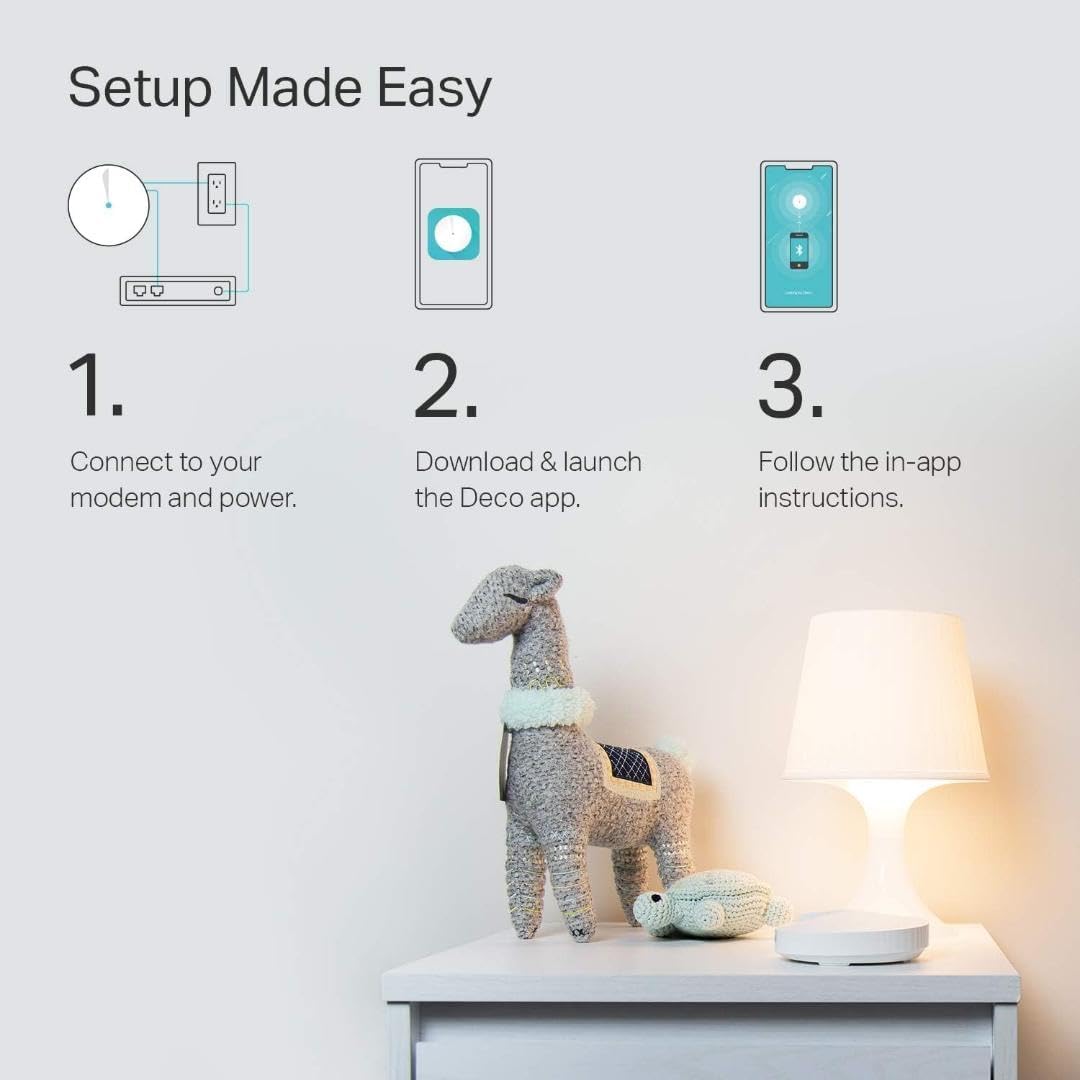
You’ll typically get the Deco M5 up and running within minutes if you follow the app prompts and have a working modem. The intention here is to eliminate the fiddly, multi‑SSID setup of extenders and give you a single network name for seamless roaming.
You’ll begin by connecting one Deco to your modem, powering them on, and using the Deco app to finish configuration. The app walks you through naming the network, setting admin credentials, and optionally enabling HomeCare features like parental controls and antivirus.

Deco app experience
You’ll interact with most of the Deco M5’s advanced features from the Deco app, which is designed to be approachable for non‑technical users. The app gives you guided setup, device management, parental controls, security settings, and simple speed tests.
You’ll appreciate the clear device lists and status indicators; the app shows which Deco each device is connected to and lets you prioritize devices or pause internet for a profile. If you prefer voice control, the Deco M5 also works with Alexa so you can do simple tasks hands‑free.
Coverage and performance
You’ll get wide coverage when you place the three Deco M5 units strategically around your home — central living areas, upstairs corridors, and home office corners are common choices. The 5,500 sq. ft. figure is an upper limit that assumes reasonable placement and typical home construction; actual results depend on walls, floors, and interference.
You’ll notice that mesh systems reduce dead zones by handing off devices between units as you move through the house. For most families juggling streaming, smart devices, and remote work, the Deco M5 should cut down on dropped connections and inconsistent Wi‑Fi in areas that were previously weak.
Real‑world speed and range expectations
You’ll rarely see theoretical maximum speeds across every room, but the Deco M5 aims to preserve as much of your broadband as possible while extending coverage. If you use wired backhaul between Decos, you’ll preserve more bandwidth for devices and reduce wireless overhead.
You’ll want to place units so they have clear line‑of‑communication when possible — avoid tucking them in a cabinet or putting them on the floor under dense furniture. Expect slightly lower top Wi‑Fi speeds at the network edge compared with a single router placed centrally, but far better reliability and throughput in previously dead zones.
Wired backhaul and Ethernet ports
You’ll get two Gigabit Ethernet ports on each Deco, which gives you the flexibility to connect wired devices or link Decos with a cable for wired backhaul. Using Ethernet backhaul between units can significantly reduce latency and improve throughput for high‑bandwidth tasks like 4K streaming or cloud backups.
You’ll also be able to use any Deco as the primary router — connect it to your modem and switch the other units to satellite mode automatically through the app. If you have a gigabit internet connection and a wired backhaul, the Deco M5 is capable of delivering your ISP speeds to multiple rooms more consistently.

Software features and security
You’ll get TP‑Link HomeCare bundled with the Deco M5, which provides antivirus, parental controls, and Quality of Service (QoS) in a single package. The product description indicates a free lifetime subscription to HomeCare, which is a helpful selling point if you care about built‑in device protection without extra ongoing fees.
You’ll use the app to enable or tune the HomeCare settings and see security events and reports. HomeCare aims to block known malware sites, quarantine infected devices, and give you granular controls for blocking categories or scheduling access for certain users.
TP‑Link HomeCare: Antivirus, Parental Controls, and QoS
You’ll likely find HomeCare’s antivirus useful if you want network‑level protection for devices that can’t host antivirus software, like some smart home gadgets. The parental controls let you create profiles for each family member, apply content filters, and schedule internet time so you can limit usage at bedtime or during homework.
You’ll also be able to prioritize bandwidth for streaming or gaming via QoS, which is handy when multiple people compete for a connection. QoS is straightforward to use in the app — you’ll assign “highest” priority to a device or two and let the Deco distribute remaining bandwidth to other connected devices.
Mesh behavior: roaming and stability
You’ll appreciate the single SSID behavior — once set up, the Deco M5 gives you one network name and password across all units, so your phone or laptop roams seamlessly between nodes. Switching between Decos should be automatic and painless as you move around the house, which feels much smoother than juggling separate extender networks.
You’ll also notice fewer connection drops in multi‑floor homes and better overall stability compared with a single distant router. The mesh is designed to route traffic through the best path available, which helps maintain speed even when one link becomes busy or noisy.
Adaptive routing technology
You’ll benefit from Deco’s adaptive routing, which automatically chooses the fastest path for each device at any moment. That means if a device is closer to one unit but the network performs better via another route, the system will adjust to keep speed and reliability high.
You’ll rarely need to manually force a device to a specific node because the adaptive system handles that handoff for you. If you do want more control, you can tweak placement or use Ethernet backhaul to give the network predictable, high‑capacity paths.
Compatibility and ISP support
You’ll be able to use the Deco M5 with most major ISPs such as AT&T, Verizon, Xfinity, Spectrum, RCN, Cox, CenturyLink, Frontier, and others — though you’ll likely still need a modem where required. Because the Deco supports standard WAN connections, it works as a router in typical home setups, but check whether your ISP requires special settings or a provider‑supplied gateway.
You’ll be able to replace your existing router in most cases, but if your ISP provides a combined modem/router unit, you may need to set it to bridge mode to avoid a double NAT situation. If you’re unsure, you can use the Deco as an access point behind the ISP gateway, though that reduces some features tied to router mode.
Use cases — who should consider the Deco M5
You’ll find the Deco M5 attractive if you’re fed up with Wi‑Fi dead zones and have multiple devices across a mid‑to‑large home. Families with streaming, gaming, smart home devices, and remote children who need parental controls will get a lot of value from integrated HomeCare.
You’ll also like the Deco M5 if you prefer a set‑and‑forget system that you manage from a mobile app rather than a technical web interface. It’s ideal for households that want consistent coverage without hiring an installer or running a lot of Ethernet cable.

Pros
You’ll appreciate several strengths of the Deco M5 that make it an appealing choice for many homes:
- Coverage for large homes when three units are used and placed well.
- Single SSID seamless roaming that removes manual network switching.
- Built‑in security and parental controls with a stated included HomeCare subscription.
- Easy setup through a friendly app and compatibility with Alexa.
- Ethernet backhaul support and two Gigabit ports on each unit for wired devices.
You’ll see that these advantages combine to make the Deco M5 a convenient, family‑friendly option that covers most typical home networking needs without too much complexity.
Cons
You’ll want to be aware of a few tradeoffs before buying:
- The Deco M5 is a mid‑range mesh product, so it won’t match the raw throughput or advanced features of higher‑end systems. If you demand ultra‑high concurrent speeds for multiple 4K streams and intense online gaming, something more premium may be better.
- Dual‑band design means the Deco M5 uses the same radios for backhaul and client traffic unless you use Ethernet backhaul; tri‑band mesh systems can offer better wireless backhaul performance.
- Advanced or enterprise‑level features (VLANs, deep packet inspection, or advanced VPNs) are not the Deco M5’s focus.
You’ll weigh these cons relative to price and convenience; for many households the tradeoffs are acceptable because the Deco addresses the most common pain points effectively.
Comparison with competitors
You’ll want to know how the Deco M5 stacks up against other mesh options and traditional setups. Compared with cheap extenders and single routers, the Deco M5 typically gives better coverage and roaming. Compared with higher‑end mesh systems, it trades off some top‑end throughput and advanced manageability for affordability and ease of use.
You’ll find that popular competitors include systems from Google Nest, Eero, Netgear Orbi, and Linksys Velop. Each competitor has its own strengths — Eero and Nest emphasize simplicity, Orbi targets high throughput and large homes with tri‑band designs, and Linksys offers a spectrum of performance tiers.
Deco M5 vs traditional router + extenders
You’ll get more consistent coverage with the Deco M5 than with disparate router and extender setups because the mesh treats your home as one network. Extenders typically create separate SSIDs and can suffer from performance cliffs; the Deco M5’s single SSID and managed handoff avoid most of those issues.
You’ll also spend less time troubleshooting dropoffs and re‑connecting devices, which feels like a big win if you’ve been wrestling with extenders.
Deco M5 vs higher‑end mesh systems
You’ll notice higher‑end mesh systems using tri‑band radios and beefier hardware will outperform the Deco M5 in maximum throughput and in environments with heavy simultaneous high‑bandwidth activity. If you host frequent online tournaments, stream multiple 4K videos while large backups run, or need enterprise features, a premium system may suit you better.
You’ll still find that the Deco M5 offers better value for the average household because it balances performance, coverage, and integrated security at a friendlier price point.
Tips to optimize your Deco M5 network
You’ll get the best results when you spend a little time on placement and configuration. Place the primary Deco near your modem in a central spot if possible, and position satellite units roughly halfway between the primary and the problem areas you want to cover.
You’ll also benefit from these practical tips:
- Elevate units off the floor and avoid enclosing them in a cabinet to prevent signal attenuation.
- Use Ethernet backhaul where possible to preserve wireless capacity for clients.
- Run the Deco app’s speed test after setup to confirm that each Deco is performing well and adjust placement if a unit reports low backhaul speed.
- Enable HomeCare features you want immediately (e.g., basic antivirus and parental schedules) and fine‑tune filters over time.
- If you have a modem/router combo from your ISP, put it in bridge mode or set the Deco to AP mode depending on whether you need Deco’s routing features.
You’ll see a big improvement in reliability with a little planning and by following these guidelines.
Troubleshooting common issues
You’ll occasionally run into setup or performance issues, but most are fixable with simple steps. Common problems include poor speeds on a satellite Deco, unexpected double NAT, or difficulty getting devices to roam smoothly.
You’ll try the following fixes:
- Reboot the modem and the primary Deco and then the satellites if speeds are inconsistent.
- Check for firmware updates in the Deco app and install them; updates can fix bugs and improve performance.
- If you experience double NAT, set your ISP gateway to bridge mode or put the Deco into access point mode depending on your needs.
- If a satellite is showing low backhaul speed, move it closer to the primary unit, remove physical obstructions, or use Ethernet backhaul for improved link quality.
- Use the Deco app to see which devices are connected to which Deco; if a device sticks to a distant Deco, reconnect the device to the network to force a fresh association.
You’ll find that many issues are resolved by placing Decos in better positions, updating firmware, or switching to wired backhaul if you have the cabling available.
Security and privacy considerations
You’ll feel more secure with HomeCare guarding your network at the router level, which is useful for devices that can’t run their own security software. Network‑level protections can block malicious sites before a device connects and reduce the exposure of vulnerable smart home devices.
You’ll want to review HomeCare settings and logs occasionally so you know what was blocked and why. If you have privacy‑sensitive devices or services, consider additional endpoint security and be mindful of where you store the admin credentials for the Deco app.
Maintenance and firmware updates
You’ll want to periodically check the Deco app for firmware updates and apply them when available to keep performance and security current. The app usually prompts you when updates are ready, and the process is straightforward.
You’ll be glad that automatic or simplified updates reduce the friction of staying current, which keeps your home network secure with minimal hands‑on maintenance.
Value and pricing considerations
You’ll likely find the Deco M5 to be a good value if your priorities are coverage, integrated security, and ease of use rather than absolute top speeds. The 3‑pack price point tends to be lower than premium tri‑band mesh systems while providing competent coverage for most mid‑to‑large homes.
You’ll factor in the included HomeCare features (advertised as a free lifetime subscription) as added value, especially if you have many devices and kids in the household. If you decide after a while you need more performance, the Deco ecosystem allows upgrading to higher models or adding wired links to extract more performance.
Final recommendation
You’ll benefit from choosing the TP‑Link Deco M5 Mesh WiFi System – Up to 5,500 sq. ft. Whole Home Coverage and 100+ Devices,WiFi Router/Extender Replacement, Anitivirus, 3-Pack if your main goals are reliable whole‑home Wi‑Fi, a simple app for management, and built‑in security and parental controls. The system targets everyday households that need coverage and convenience without the complexity of enterprise gear.
You’ll get the best experience by planning unit placement, enabling HomeCare protections, and using Ethernet backhaul where available. If you need extreme throughput for large numbers of simultaneous 4K streams or very advanced networking features, consider comparing higher‑end options — otherwise, the Deco M5 represents a practical, family‑oriented mesh solution.
Where to buy and final notes
You’ll find the Deco M5 available from major online retailers and electronics stores; prices often fluctuate with sales and promotions. Before buying, you’ll want to check the packaging to confirm it’s the 3‑pack and read the most recent reviews to verify firmware and HomeCare terms haven’t changed.
You’ll be set up for a smoother Wi‑Fi experience once you get it running and follow the placement and configuration tips above. If you have more specific needs or want help choosing placements in your home, ask and you’ll get tailored suggestions based on your floorplan and usage patterns.

Disclosure: As an Amazon Associate, I earn from qualifying purchases.